

How can hydropower infrastructure remain reliable and resilient in a rapidly changing climate?
In Côte d’Ivoire, that question is no longer theoretical. Climate change is already reshaping the country’s hydrological patterns, with shifting river flows, rising temperatures and intensifying flood risks redefining how hydropower systems operate. Yet within this disruption lies an unexpected opportunity: the potential to expand renewable energy generation while strengthening resilience.
To navigate this complex landscape, Tractebel has developed a Climate Risk Management Plan (CRMP) that translates climate science into practical tools for operators and policymakers. The goal is clear – support long-term energy security while preparing the hydropower sector for an uncertain future.
Between 2020 and 2022, Tractebel worked alongside national stakeholders to assess climate vulnerability and identify adaptation pathways across ten existing and planned hydropower schemes. Spanning the Bandama and Sassandra river basins, the study combined historical climate data, long-term projections and system stress tests, following the International Hydropower Association’s Climate Resilience Guide.
What emerged is a striking dual reality. Climate change introduces new operational risks, but it also opens the door to significantly increased generation capacity. Under the most plausible 2040 scenario, annual river flows could boost hydropower potential by up to 30% in the Bandama basin and 47% in the Sassandra basin. These gains, however, are coupled with heightened exposure to flooding and heat stress, particularly affecting transmission infrastructure.
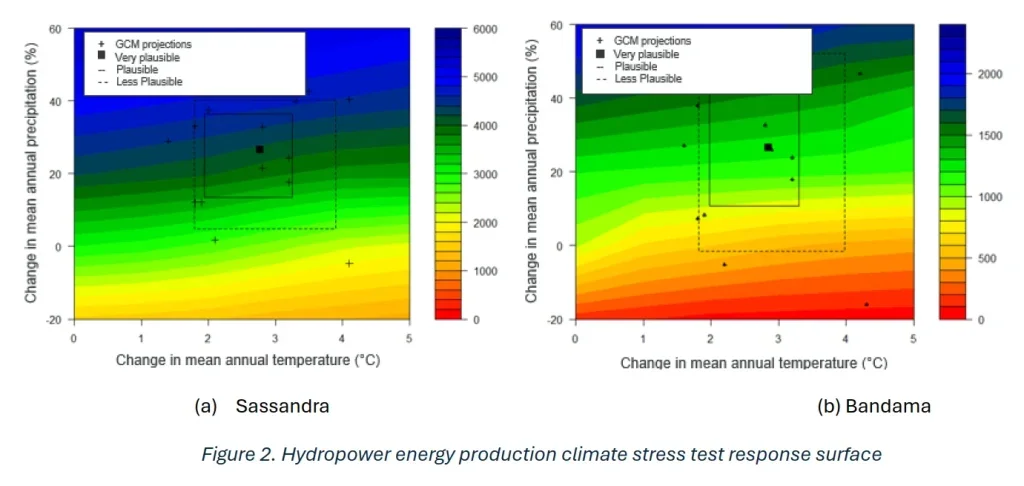
Recognising this balance between risk and opportunity, the CRMP moves beyond analysis into action. It is built around three interconnected pillars: operational improvements such as real-time water management tools and enhanced hydrometeorological networks; strategic guidance on climate-resilient infrastructure and long-term adaptation pathways; and a monitoring framework tracking key indicators including precipitation, streamflow, temperature and system performance, with updates recommended every ten years.
A defining feature of the project has been its emphasis on collaboration. Local stakeholders were closely involved throughout, ensuring that recommendations were grounded in operational realities and could be effectively implemented. This participatory approach not only strengthens the technical robustness of the plan but also builds long-term ownership and institutional capacity.
“This project illustrates how climate risk assessments can go beyond diagnostics and directly support concrete decision making, for a real impact on people,” says Julien Sanchez, Project Manager. :During our concertation sessions , I was very impressed by the level of involvement of the local stakeholders on this matter. By working closely with them, we were able to co-develop adaptation pathways that are both technically robust and operationally relevant for the future of Côte d’Ivoire’s hydropower sector.”
As climate pressures intensify across West Africa, Côte d’Ivoire’s experience offers a compelling example of how forward-looking planning can transform uncertainty into opportunity – securing existing assets while unlocking new renewable potential for the decades ahead.
Source: Tractebel


