

Tanzania has officially inaugurated the 2115MW Julius Nyerere Hydropower Plant, marking the completion and commissioning of the country’s largest hydropower project.
Tanzanian President Samia Suluhu Hassan and Egyptian Prime Minister Mostafa Madbouly attended the inauguration ceremony on 22 August. Madbouly represented Egyptian President Abdel Fattah El-Sisi at the event.
The $2.9bn project was implemented by an Egyptian consortium comprising Arab Contractors and Elsewedy Electric. Construction was carried out over a contractual implementation period of 42 months.
Located on the Rufiji River in southern Tanzania, the development includes a 2115MW powerhouse equipped with nine 235MW vertical Francis turbine-generator units. Electricity from the plant is connected to Tanzania’s national grid through a 400kV switchyard and transmission infrastructure.
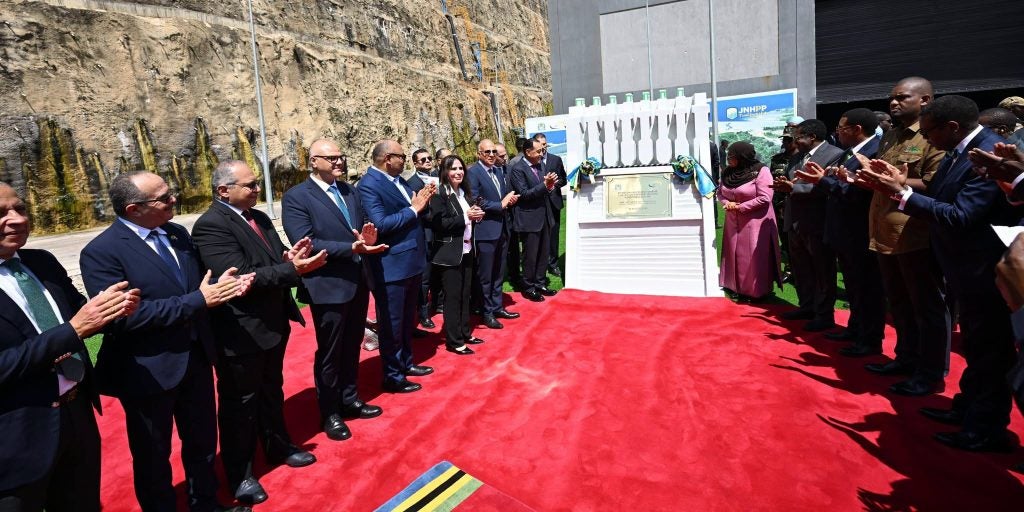
During the inauguration, Hassan and Madbouly toured the powerhouse, switchyard and main dam before unveiling a commemorative plaque marking the project’s commissioning and start of operations.
The project includes a roller-compacted concrete main dam across the Rufiji River. The structure is approximately 131m high and more than 1km long, creating a reservoir with a storage capacity of around 34 billion m³. Seven radial gates form part of the main spillway, while the wider development also includes four auxiliary dams and an emergency spillway.
Other works included a 660m river diversion tunnel, permanent and temporary access roads, a bridge across the Rufiji River and associated control, monitoring and grid connection facilities.
Speaking at the inauguration, Madbouly said: “The successful implementation of this major Tanzanian project over 42 months of hard work, at a cost of approximately $2.9bn and with an electricity generation capacity of 2115MW, demonstrates the capabilities and potential of Egyptian companies to implement major projects at the international level, particularly in our sisterly African continent.”
In addition to electricity generation, the scheme is intended to regulate flows on the Rufiji River, reduce flood risks and provide stored water throughout the year. The project is also expected to support agricultural and fishing activities.
The Julius Nyerere development was awarded to Arab Contractors and Elsewedy Electric in December 2018.