

Fish passage projects have been described as being like a journey. It’s not possible to simply build a facility and walk away. They continue to evolve as new challenges and uncertainties emerge, requiring a lot of hard work from dedicated professionals over many years to make incremental progress. The above reflections are from a BC Hydro team in Canada which has spent the past 15 years planning, designing, constructing, and operating temporary and permanent fish passage facilities at The John Horgan Dam and Generating Station (formerly known as Site C) on the Peace River in northeastern British Columbia.
As Nicolas Burnett, Sarah Prior and Brent Mossop from BC Hydro, along with Vincent Autier from engineering company McMillen SAS, say: “We have a responsibility to design facilities that can operate across a wide range of environmental conditions, pass a diverse assemblage of fish species, and continually monitor fish passage so that we can maximise biological effectiveness now and in the future.”
BC Hydro recently completed construction of the former Site C Project which is the third hydroelectric dam on the Peace River, and implemented a staged approach to upstream fish passage at the site. A temporary upstream fish passage facility was operated during the river diversion phase of construction from 2020 to 2024. Following the closure of the diversion tunnels and reservoir filling in 2024, it began operating the permanent upstream fish passage facility at the outlet of the generating station to provide for upstream fish passage during the operations phase of Site C.
Burnett et al say they had the unique opportunity to build and operate a temporary facility at scale for four years. Any surprises and mistakes they encountered – no matter the scale or implication – reinforced the unique opportunity to learn from the temporary facility and apply those learnings to the permanent facility that could operate for the100-year design life of the dam and generating station.
The authors say their provision for upstream fish passage at Site C was complicated by:
- Uncertainty in the future fish community that would establish in the new reservoir and the Peace River downstream of the dam site, and the future movement patterns of these fish.
- Corresponding uncertainty in future management objectives for the new fish community.
- A diverse fish community with several less studied species for passage.
- The dam’s height of 60m.
- A need for operational flexibility in passing some (but maybe not all) species upstream of Site C.
They add that they learnt a lot of lessons, spanning a wide range of topics and disciplines, and felt it was important for others to hear and consider applying these to their work at new or existing facilities.
Lessons learnt include:
- Benefiting greatly from collaborating with and seeking the guidance of experts, and their efforts to regularly connect with academia, government agencies, and other utilities were invaluable.
- Engaging with parties such as Indigenous nations and regulatory agencies early on and throughout the process. This will help alleviate concerns, reach common ground, and lead to stronger relationships and partnerships to continue advancing this important work.
- Taking the time to carefully consider the location and orientation of the fishway entrance.
- Designing and planning for future conditions and operational flexibility.
Incorporating operator safety into the design. BC Hydro said it recognised early on that the design principles and criteria were often focused on maximising fish health and survival and less on the safety of the people tasked with operating and maintaining fish passage facilities. BC Hydro says worker safety was a top priority at Site C because the need to sort and transport fish introduced operator involvement and potential hazards that needed to be controlled.
Burnett et al conclude that despite improvements in attraction efficiency, passage and trapping success, there is still room for improvement in the biological effectiveness of the permanent facility at the John Horgan Dam. They believe sharing their lessons should prove useful to practitioners, natural resource managers, biologists, and engineers involved in new or existing fish passage projects elsewhere. .
CONUS Census
The current state of knowledge regarding the implementation of fish passage infrastructure at hydropower projects in the US is described as being incomplete and outdated.
Understanding where, how, and why fish passage facilities are installed is particularly important in today’s rapidly evolving hydropower landscape, as the US hydropower community (resource managers, regulators, industry, and environmental advocacy groups) seeks to modernise and strengthen its hydropower fleet while simultaneously implementing effective basin-scale fisheries management.
In the first conterminous US (CONUS)-scale dataset of fish passage facilities at US hydropower developments in over 30 years, Matson et al identified 2729 active hydropower features as potentially impeding the movement of migratory fish within rivers. Their dataset reported the existence (presence or absence) of fish passage facilities at 70% of these hydropower developments, 390 of which had at least one fish passage facility, and almost half were licensed by FERC.
Fish passage facilities were most common at FERC licensed projects, followed by US Army Corps of Engineers-owned features, then FERC exempt features, those with unknown regulatory status, and finally Bureau of Reclamation projects. Most had a single passage facility that provided passage in only one direction, with downstream being more common than upstream passage. Bypasses and ladders accounted for 60% of the fish passage facility types. Fish passage facilities were most common in the New England, Pacific Northwest, Mid-Atlantic, and Great Lakes regions. The research team also identified regions where information is lacking, particularly in California and the Mountain West. In general, fish passage facilities were more common at features that were closer to the ocean, at lower elevations, and at shorter dams, but not related to installed electrical generation capacity. Hydrologic sub-basins containing salmonids also contained the largest number of hydropower features, but the proportion of features with passage was generally higher in sub-basins containing multiple migratory taxa.
As the authors explain in their study published in The Journal of Environmental Management, hydropower developments represent a very small fraction (<3%) of the 92,000 dams that could potentially impede the movement of migratory fish species.
“Consequently,” Matson et al say, “this dataset should not be construed as a tool to evaluate connectivity; rather, it is a census of our progress toward building a hydropower fleet that simultaneously protects valuable fishery resources while providing affordable, reliable energy for the benefit of the American public.”
Of all FERC-licensed features included in this dataset, 40% will be within five years of licence expiration by 2035, the point at which pre-filing consultation stages of the relicensing process would be expected to begin. Results presented in this study show there are likely to be many developments that may be required to install passage facilities for the first time, or upgrade existing facilities to improve efficacy, or accommodate additional migratory species as a condition of obtaining a new licence.
Eels also present a different challenge for fish passage given their unique life history and swimming and climbing capabilities. Downstream passage of adult eels is challenging because their behaviour, size, and shape make it difficult to prevent turbine passage using traditional fish protection measures. Passage facilities that were specified in the dataset as applying to eels are likely not useable by other species. Eel-specific passage facilities in the dataset were highly variable, ranging from simple spat ropes that juvenile eels can use to climb over a spillway, to mechanical eel lifts that require supervisory control and data acquisition systems.
Some hydro developments may alter their operational schedule during certain times of year and day (such as nightly shutdowns) when eels migrate downstream to try to prevent entrainment, injury, or mortality associated with through-turbine passage. The authors also add that recent advances in fish-friendlier turbine technology are promising for safe turbine passage for eels (100% survival after 48hours) and other fish, with no or very low mortality. Unfortunately, the authors conclude that the presence of fish passage facilities “does not automatically equate to safe, timely, and effective passage of large numbers of migratory fishes”.
A central issue to quantifying passage efficacy is the lack of specificity in what it means to be successful, both in terms of defining and evaluating the targets for passage performance. Matson et al give the example of counting the number of fish that exit the upstream end of a fishway as one method of assessing performance. However, this does not provide insight into how many fish encountered (or could not locate) the downstream entrance, or how long it took fish to navigate the fishway. Matson et al say their census “provides valuable information on existing fish passage mitigation and is a benchmark to gauge progress toward a modernised hydropower fleet that provides affordable, reliable energy while protecting fishery resources”.
Making fish safe
Although Matson et al’s above study did not consider turbine passage as downstream fish passage, replacing older turbine designs with fish-friendlier turbines potentially has economic implications for hydropower projects approaching licensing. This is because turbine upgrades may be a viable fisheries management strategy instead of implementing other more costly fish passage and protection measures. In fact recent research suggests that in-stream turbine passage may be a realistic mechanism for safe, timely, and effective downstream passage for multiple species. A new peer-reviewed study has recently highlighted how fish survival can be dramatically improved with a straightforward upgrade path, with fish-friendly turbine manufacturer Natel independently validating its technology.
Natel partnered with the Fangue Fish Conservation Physiology Lab at the University of California, Davis. Funded by a competitively awarded grant from the US Department of Energy, and co-authored by members of the Fangue Lab and Natel, the study evaluated injury and survival outcomes for juvenile white sturgeon.
Much like salmon, sturgeon are anadromous fish that mature in saltwater environments before returning to freshwater rivers to reproduce. Every few years, adults travel upstream seeking cold, fast-moving currents to spawn. Because sturgeon are exceptionally long-lived, individual fish migrate multiple times over their lifespans. Sturgeons are currently considered the most endangered group of species on Earth.
The controlled experiment, conducted under the guidance of the Institutional Animal Care and Use Committee at UC Davis, compared a conventional runner profile (thin, straight leading edges) to a Natel FishSafe runner (designed with thick, slanted leading edges) at the same hydraulic head and rotational speeds. During the trials, 112 juvenile white sturgeon were passed through the Natel FishSafe runner and 115 through the conventional runner. To establish a baseline for handling and facility survival, an additional control group of 125 fish were passed through the system, bypassing the turbine. Unnecessary trauma was limited and all fish were anesthetised prior to passage. To improve understanding of how fish interact with the runner blades, every passage event was filmed using high-speed video, and fish were assessed for injuries both immediately and after a 48-hour observation period. The only operational variable changed was the blade shape. Tests were conducted at five blade peripheral speeds ranging from 15.0 to 27.6m/sec.
Under equivalent hydraulic conditions, the 48-hour survival rates for the FishSafe runner were 100% across nearly all speeds, with only one delayed mortality at the highest speed tested. In comparison, survival rates for fish passing through the conventional runner were between 42% and 78%, with approximately one-third of the tested fish suffering fatal severing injuries.
The research team also noted that the analysis of strikes observed in the high-speed video footage revealed that the FishSafe runner exposed fish to a much lower strike probability than the conventional runner. It is claimed that this data demonstrates how Natel FishSafe turbine blade profiles can successfully eliminate the historic trade-off between clean energy generation and fish protection.
Restoration project
The Walla Walla District of the US Army Corps of Engineers (USACE) has issued a five-year construction licence to the Benton Conservation District (BCD), for the Amon Creek Habitat Restoration Project. This is a US$1.2 million initiative aimed at improving fish habitat and migration conditions at the Yakima Delta Habitat Management Unit near McNary Lock and Dam.
The project will reroute approximately 426m of the lower Amon Creek channel to connect with a deeper pool in the Yakima River. A low-flow deflector will also be installed to maintain Amon Creek’s cooler waters during summer months while creating natural scour at higher flows. These changes are expected to increase average water depth from 0.5 to 1.6m, creating cooler, deeper habitat for salmon and trout.
The project is led by BCD in coordination with Mid-Columbia Fisheries and Yakama Nation Fisheries, with support from the Yakima Basin Integrated Plan, the Washington Department of Ecology, and the Salmon Recovery Funding Board.
In addition to cooler waters, initial assessments determined the project could also reduce physiological stress while improving reproductive outcomes for salmonid populations. Work will also include planting native vegetation to improve channel stability, water quality, and riparian habitat.
Construction is scheduled to begin in winter/spring 2026 and be completed by spring 2027. The project will be built in three phases: creating the new channel, installing the deflector, and dewatering and replanting the old channel.
Innovative project
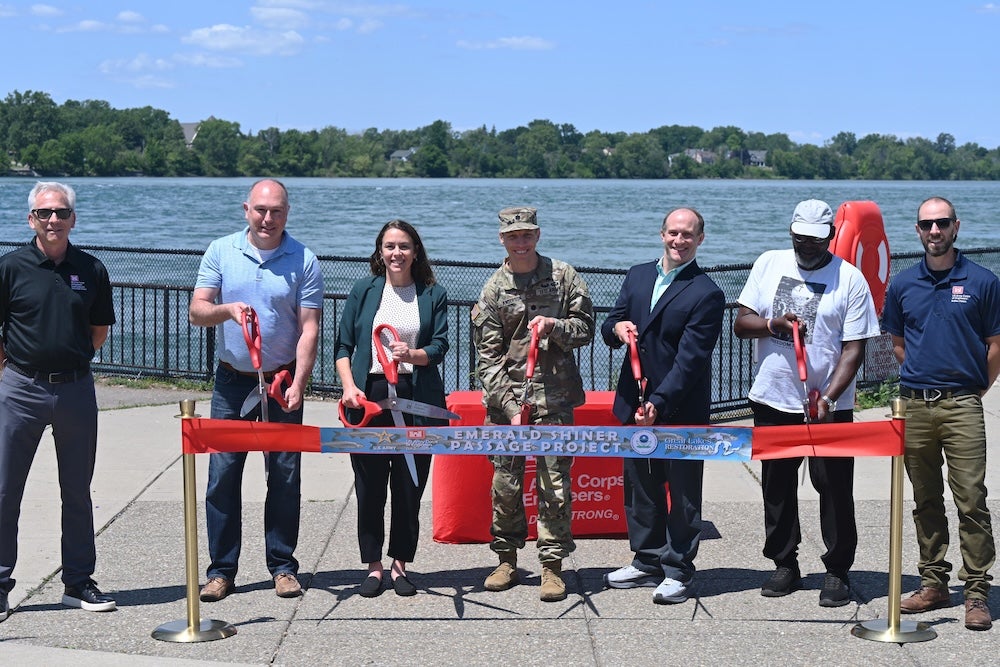
Meanwhile, the Buffalo District of USACE, the US Environmental Protection Agency and the City of Buffalo celebrated the completion of an innovative US$13.4m fish passage project that helps the emerald shiner – one of the Great Lakes’ most important fish – overcome the powerful currents of the Niagara River to move upstream after spawning. Funded entirely by the EPA’s Great Lakes Restoration Initiative, the Emerald Shiner Fish Passage ensures a critical food source for larger fish and wildlife. It directly supports the US$5.1bn Great Lakes recreational fishery and brings the region one step closer to the goal of delisting the Niagara River as a Great Lakes Area of Concern.
The passage utilises a series of specially designed, concrete-filled steel baffles mounted to the park’s seawall. These create channels of slower water that shiners can swim against. Measurements following construction confirmed water velocities have dropped below the shiners’ swimming threshold.
The final phase of the fish passage was constructed from March 2025 to May 2026 under an US$11.8m contract awarded to Buffalo-based Bidco Marine Group. It spans 213m along the seawall at the south end of Freedom Park. Construction included repairs to the timber crib wall, the installation of steel plates at the waterline and the attachment of the concrete-filled metal baffles.
Though small and seemingly abundant, the emerald shiner is a critical prey fish at the base of the food web in the Niagara River and Lake Erie. Its population has been threatened by hydraulic barriers. Previous studies by USACE, the University at Buffalo and SUNY Buffalo State University identified this stretch of the river as moving too fast for the fish to navigate.
Buffalo District team members have already observed shiners passing through the project into upstream portions of the river in groups of hundreds. The team has also observed common terns hunting fish along the seawall – an activity never previously seen at the site.
Herring populations
River herring populations are reported to be at historical lows across their native range along the East Coast of North America due to overfishing, and habitat loss through degradation and damming. In the last 200 years, dams and other impoundments have reduced access to spawning habitat for these and other anadromous fish.
To assess the theoretical coast-wide spawning potential for river herring, Snyder et al quantified historically accessible spawning habitat (pre-dam) in coastal freshwater rivers using physical river characteristics such as width and gradient. And to assess the impact of dams on spawning habitat, a dams database was used to segment river reaches. This enabled characterisation of spawning habitat upstream and downstream of the dams. River-specific population models were then used to estimate the number of potential spawners for each species, based on habitat estimates and life history parameters. Three different scenarios were investigated: no dams, favourable dam passage, and no dam passage.
The results showed that an estimated 52% of alewife and 51% of blueback herring habitat were located upstream of dams throughout the East Coast of North America. The authors claims that this results in a theoretical loss of ~880 million alewife and ~100 million blueback herring potential spawners due to dams, reducing both the ecological connection and fishery potential of these species.
Marine matters
Although habitat fragmentation is a major threat to aquatic biodiversity loss, much less attention has been given to the connectivity of marine ecosystems than freshwater. New research contends that coastal infrastructure including tidal turbines have resulted in underappreciated impacts on the connectivity of fish movements, resulting in passage challenges at sea. As tidal turbines are placed in areas with high currents, these can hinder fish movement and result in entrainment, and monitoring this is in such unique areas can be very challenging.
“Unencumbered passage of animals in the marine realm is underappreciated and underdeveloped as a distinct research theme of marine ecology,” Lennox et al say in their study in Marine Ecology.
Given the sparsity of published literature, Lennox et al say theirs is “a narrative and not a systematic review”. In some instances, the evidence base was so small the authors even had to rely on their own experience to contemplate potential impacts. With marine ecosystems being so vast, it is presumed that fishes, mammals, turtles and other creatures can simply avoid any barriers by swimming around them. However, the authors claim that the growing abundance of marine infrastructure is creating challenges to connectivity within the marine environment, which have not yet been thoroughly addressed by science or engineering, particularly from the perspective of fish passage.
“It is imperative that we assess the potential connectivity issues resulting from marine infrastructure and that we generate solutions to mitigate these issues for marine organisms,” the authors add.
Tidal turbines occur in restricted areas where currents are forced through narrow channels, such as the Minas Passage in the Bay of Fundy in Canada or the flows between the Orkney Islands in Scotland. In areas such as the Minas Passage, these channels may represent the only migratory pathway between the ocean and essential reproductive or foraging habitats for a variety of marine and diadromous fish species. There may also be fish collisions which result in injuries and mortality, along with displacement or disruption of migratory routes. Indeed, electromagnetic fields emanating from the subsea cables transferring power from the generating site to stations onshore are believed to present a challenge to the many animals that use magnetic cues for navigation.
The authors explain that there are opportunities to install non-physical barriers, based on sensory capabilities (such as bubble curtains, electricity strobe lights, or carbon dioxide), at turbine sites. Such solutions would not only minimise the risk of injury or mortality but also guide organisms around infrastructure, mitigating barriers to connectivity caused by the turbines. According to the authors, much work is still needed to understand how effective such approaches can be and how species-specific some interventions are.
Tidal streams can offer a free ride to animals that wish to move while conserving energy, and species like eels may use tidal stream transport as part of their mobility strategy. And in such high flow areas periodic shutdowns during migratory seasons may be necessary. Lennox et al believe their review has identified several priority areas for research that could help forge new partnerships between biology and engineering disciplines to enhance the sustainability of marine infrastructure and the development and improvement of marine habitat.


