

This article is intended to attempt to explain the perceived ambiguity presented in some recent technical articles and reports between the postulated failure mechanisms or types of collapses in shotcrete lined hydropower tunnels as slow progressive failures also described as cyclic fatigue, versus the postulated root cause for such collapses based on detailed forensic investigations with particular reference to the reported conclusions implied by Hansson (2020) and Nordstrom (2021). These reports reference past collapses and the importance of routine technical inspections of hydropower tunnels which is fully supported given their critical function as part of a total hydropower asset.
Hydropower tunnel collapses database update
The largest database of hydropower tunnel collapses was compiled by Palmstrom (2003), who questioned whether several historical failures in Norwegian hydropower tunnels could be attributed to inadequate maintenance. The causes of these historical collapses have generally been associated with three principal mechanisms: the presence of swelling clays, sliding of rock within weakness zones, and variations in hydrostatic pressure within the tunnel. Hakansson (2013) also concluded that most collapses occurred relatively soon after the tunnels were filled and brought into operation.
Brox (2017) subsequently produced the first graphical analysis of historical hydropower tunnel collapses based on the number of operating years before failure, covering 38 cases. By 2018, the increasing frequency of collapses involving recently completed projects had become recognised by the international insurance industry. Brox (2018) attributed this trend primarily to design errors rather than construction quality. The graphical analysis was subsequently updated by Brox (2020) to include 48 cases, with a further update by Brox (2022) expanding the database to 53 cases. Notably, the majority of the recorded collapses occurred in sections incorporating final shotcrete linings.
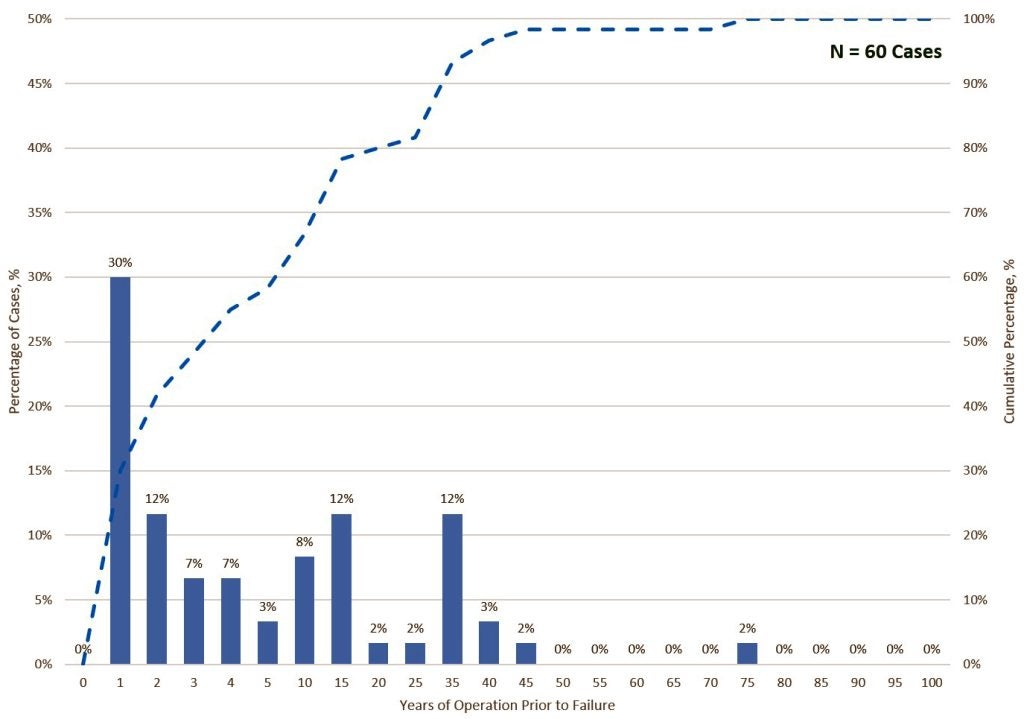
The database has now been further updated to include a total of 60 cases (Figure 1). The frequency and cumulative frequency data shown in Figure 2 reveal that around 30% of collapses occurred within the first year of operation, including during commissioning. Around 60% occurred within the first five years, while approximately 80% took place within 15 years of the start of operations. These findings indicate that a significant proportion of collapses are unlikely to be associated with the slow, progressive failure mechanisms proposed in previous studies. Instead, the relatively early occurrence of many failures points towards mechanisms and root causes associated with design and/or construction. Figure 1 also suggests that the collapses may broadly fall into two categories: short-term failures associated with early degradation mechanisms and increased loading, and longer-term failures resulting from progressive processes such as erosion and scour. The latter appear to include cases documented by Palmstrom (2003), which were associated with relatively short and discrete weakness zones.
Root cause of hydropower tunnel collapses
The root causes of the more recent early collapses occurring since 2009 have been evaluated in detail by Brox (2024), based on post-collapse forensic investigations undertaken on behalf of insurers and project stakeholders. Analysis of 12 cases since 2009 concluded that the likely root cause was design errors involving inadequate initial tunnel support and final linings, arising from a failure to recognise the additional loads imposed on tunnel linings following saturation of surrounding water-sensitive rock conditions. The consequences have been substantial. Repair costs for the most recent collapses have each exceeded $120 million, with repair programmes extending beyond 36 months, resulting in significant additional project costs and losses in revenue.
Saturation of the surrounding bedrock can occur when the shotcrete lining cracks under internal hydraulic pressures that may exceed 5–10 bar. This is particularly relevant for irregular drill-and-blast profiles, where blast damage may further increase susceptibility to cracking. Such pressures are significant and can allow water to penetrate the surrounding rock mass.Bedrock saturation can subsequently reduce the strength of water-sensitive materials, including clays associated with faults and fracture zones, as well as degradable, water-sensitive vein-filling minerals such as laumontite. This proposed root cause is strongly supported by evidence from many of the 12 recent cases examined. In these cases, varying degrees of damage were observed elsewhere in the shotcrete linings, including severe cracking and rupturing without collapse. These features are considered precursor stages of failure and were associated with lower levels of adverse water-sensitive conditions than those identified at the collapse locations.
The root cause of this latter group of deferred collapses, 40% of which occurred more than five years after construction, is also considered to be design errors involving inadequate support and final linings at unidentified localised or discrete weak zones within otherwise predominantly good-quality rock conditions. This was the case for the majority of projects in Norway and Sweden. Identifying these isolated weaknesses has been likened to finding a needle in a haystack and remains a significant challenge for the hydropower industry.
The root cause of these recent collapses is considered to be design errors involving inadequate initial support and final linings, arising from key decisions made during construction. These errors reflect the limitations of both detailed visual inspections and the simplified geotechnical design standards commonly used to describe and characterise ground conditions encountered during construction. The key factors considered to have contributed to these design errors, and consequently to the increased near-annual rate of collapses, include the following::
- Project delivery methods of design-build (EPC) for fast-track project execution to meet power purchase agreement deadlines to avoid penalties and/or investor funding deadlines;
- Project sites increasingly located in adverse geotechnical conditions despite attractive hydrology and associated energy generation profile;
- EPC design and construction executed with inadequate time for detailed geotechnical investigations and testing to fully appreciate and understand the behaviour of water sensitive (saturated) geological formations and mineralogy;
- Limited geotechnical investigations and testing assuming optimistic conditions with the dismissal of low strength and durability values recognized as outlying results and an incomplete understanding of saturation-induced strength reduction and behaviour of the surrounding rock conditions during hydraulic operations;
- One-pass construction approaches whereby the decisions for final support and linings are made rapidly, and often by young professionals, during excavation advance including for TBMs, and;
- The acceptance of final shotcrete linings by many designers as a cost-savings alternative assuming equivalent long-term durability and performance to concrete linings with the misunderstanding that shotcrete linings are of high permeability and deformability especially for irregularly-shaped drill and blast tunnel profiles.
Routine unwatered inspections using remote operated vehicles (ROVs)
Given the continued, and in some cases increasing, use of aggressive design approaches for major hydropower projects, particularly those delivered under design-build or EPC contracts, there is a growing reliance on shotcrete as the final lining for long hydropower tunnels to minimise overall project costs. Against this background, routine inspections of water-filled tunnels using remotely operated vehicles (ROVs) are strongly recommended, with inspection frequency determined by past, current and anticipated hydraulic operating conditions (Brox, 2020; 2022).
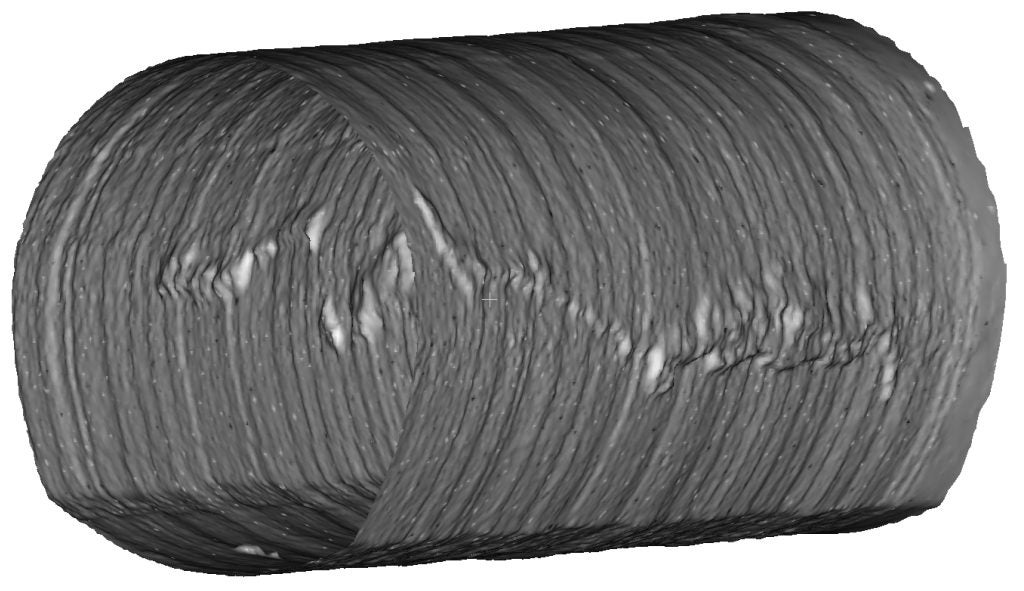
Figure 3 presents a high-resolution three-dimensional (3D) model generated during an ROV inspection using 3D multibeam sonar in a 22km-long headrace tunnel. The inspection identified a 35m-long section of distressed concrete lining after 13 years of hydraulic operation. Over a three-year period, pieces of concrete had become dislodged from this section and were transported approximately 13km along the headrace tunnel into the powerhouse, posing a risk to power generation. The inspection results indicated a compression-type rupture of the concrete lining at a location characterised by very weak geotechnical conditions. As-built records confirmed that additional invert support had been required at this location during construction. The ROV inspection enabled the affected section of the headrace tunnel to be accurately identified, providing justification for dewatering and a subsequent physical inspection. This information also supported the detailed planning and successful execution of repairs to the localised area (Brox et al., 2023).
It is strongly recommended that project developers require warranty periods of at least two years, and potentially up to five years, for new hydropower projects where shotcrete forms any part of the final lining of a headrace tunnel, given the critical role of these tunnels within the overall project. In addition, developers should incorporate routine inspections of water-filled tunnels into project requirements, while insurers should consider making such inspections mandatory where shotcrete-lined hydropower tunnels form part of the design. This is particularly important given the near-annual occurrence of tunnel collapses recorded across the industry. Recognition of the risks associated with shotcrete-lined hydropower tunnels is also considered consistent with the emerging use of inherent defects insurance (Keime, 2025), intended to address the coverage gap between construction and operation. Where possible, these inspections should be undertaken using ROVs without dewatering the tunnel. This avoids the risks associated with rapid dewatering for physical inspection, which may not allow sufficient time for pore pressures in the surrounding rock mass to dissipate. Under such conditions, elevated pore pressures can contribute to block dislodgement, localised collapses and, in more severe cases, complete tunnel blockages.
Risk evaluation of new and aging hydropower tunnels
Ageing hydropower tunnels are increasingly susceptible to deterioration and the need for repair, yet their risk profile is often given less attention than that of dams and powerhouse structures. Asset risk assessments for major hydropower plants incorporating headrace tunnels should therefore carefully consider the distribution and type of final lining, whether unlined, shotcrete or concrete, together with the hydraulic operating regime, including whether the plant operates in peaking or non-peaking mode. The risk assessment methodology developed by Rosin (2005) is considered a reliable means of identifying residual risks associated with adverse conditions and establishing an overall risk profile for a hydropower tunnel. This assessment should be supported by a thorough review of the tunnel’s historical performance, including concerns identified during previous inspections and details of completed repairs. Together, this information can provide a more robust basis for determining the need and frequency of future inspections, particularly given the outage requirements and associated economic impacts on power generation.
This risk-based approach differs from that proposed by Nordstrom (2021), instead supporting more frequent inspections based on industry-derived risk criteria (Brox, 2021). Access is becoming less of a constraint, as ROV technology can now inspect long sections of tunnel from a single launch location, with distances of up to 18km achieved to date. ROV inspections therefore provide a practical and technologically proven alternative for obtaining reliable information on the condition of hydropower tunnels.
Finally, many aged hydropower tunnels that were constructed in fair to good quality bedrock conditions with justified limited linings have performed satisfactorily for decades without any need for repairs. However, these tunnel performances should not be simply assumed to be expected in other project regions, and in particular in geologically young regions of volcanic bedrock, where more adverse and water sensitive geotechnical conditions may be present. Hydropower tunnels are being increasingly designed and constructed in more unfavorable conditions within such high-risk site conditions whereby more conservative design approaches should be adopted to avoid the recent track record of near-annual collapses.
References
Hansson, M. 2020. Energiforsk Report 660, Inspection of water-filled rock tunnels (in Swedish).
Nordstrom, E. 2021. Energiforsk Report 730, Inland Waterway Management Strategy (in Swedish).
Palmström A. (2003). Slides and collapses in Norwegian water tunnels – a maintenance problem? Conference on Vassdragsteknisk forum, arranged by Norwegian Electricity Industry Association, Oslo, 6 p. (in Norwegian).
Hakansson, W. 2013. Durability of power plant tunnels: A study on aging phenomena and degradation processes, Master of Science Thesis, Engineering geology, LTH, Lund University (in Swedish).
Brox, D.R. 2017. Practical Guide to Rock Tunneling. Tayor and Francis. Pp. 248.
Brox, D. 2018. Hydropower Tunnel Failures – Risks and Causes. London Engineering Group Conference, Chesham, England. October 18-19.
Brox, D. 2020. Hydroelectric Tunnel Inspections – Recommendations for Industry Practice, Hydropower & Dams, Issue 5.
Brox, D. 2022. Hydroelectric Tunnel Inspections – Recommendations for Industry Practice, HYDRO2022 Presentation update.
Brox, D., Wangdi. S., and Namgyal, D. 2023. Correlation of ROV Observations with Actual Damage in the Tala Headrace Tunnel, World Tunnel Congress, Athens, Greece.
Brox, D. 2024. Key Principles for the Planning, Design, Construction, Operations, and Inspection of Hydropower Tunnels: 2024 Update from Lessons Learned in the Industry
Rosin, S. 2005. Geotechnical Risk Assessment and Management for Maintenance of Water Conveyance Tunnels in Southeastern Australia. Presented at the Australian Geotechnical Society–Australian Underground Construction and Tunnelling Association Mini- Symposium: Geotechnical Aspects of Tunnelling for Infrastructure Projects.
Keime, J. 2025. Inherent Defects Insurance is a win-win for insurers, governments and society, SwissRe Engineering Article.


