

Tanzania has formally inaugurated the Julius Nyerere Hydropower Project, bringing to completion a development that has reshaped the country’s electricity system and delivered one of the largest hydroelectric power stations in Africa.
Located at Stiegler’s Gorge on the Rufiji River, the US$2.9 billion project combines a major dam and reservoir with a 2115MW powerhouse containing nine 235MW vertical Francis turbine-generator units. The plant was officially inaugurated on 22 August 2026 by Tanzanian President Samia Suluhu Hassan, accompanied by Egyptian Prime Minister Mostafa Madbouly.
The ceremony marked the culmination of a project constructed for the Tanzania Electric Supply Company, TANESCO, by an Egyptian consortium comprising Arab Contractors and Elsewedy Electric. Civil works were led by Arab Contractors, while Elsewedy Electric was responsible for the electromechanical systems and associated electrical infrastructure.
Although the inauguration represented the project’s formal completion, its generating units had entered service progressively. The first 235MW unit was connected to Tanzania’s national grid in February 2024, with the remaining machines commissioned in phases. All nine units were reported to be operational by April 2025.
This staged commissioning allowed the project to begin supporting the grid well before the formal opening. Its arrival was particularly significant because Tanzania had experienced electricity rationing during periods of reduced generation and rising demand. Before the first Julius Nyerere unit entered service, the country had around 1900MW of installed generating capacity, according to figures reported at the time.
With the new plant alone rated at 2115MW, Julius Nyerere has therefore more than doubled the generating capacity available to the Tanzanian system compared with the pre-commissioning position. Its scale also gives the country greater scope to meet domestic demand, support industrial development and consider increased cross-border electricity trading.
Harnessing the Rufiji
The scheme is built across the Rufiji, Tanzania’s largest river, approximately 220km southwest of Dar es Salaam. The river drains a substantial basin covering much of southern Tanzania before discharging into the Indian Ocean.
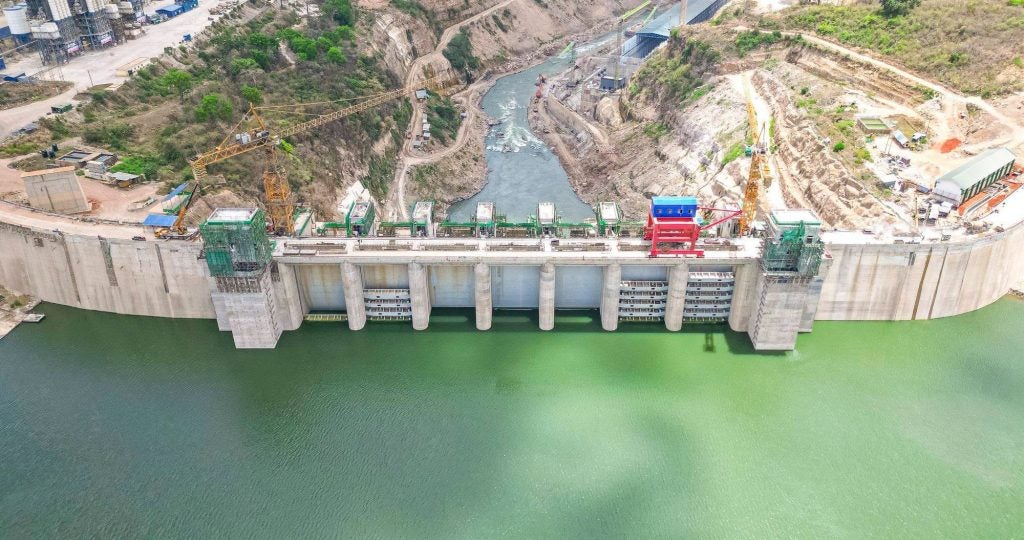
At the centre of the project is a concrete dam approximately 1025m long and 131m high. Construction required about 3.5 million cubic metres of roller-compacted concrete, creating a substantial civil structure across the gorge.
The main dam incorporates a central gated spillway with seven radial gates. An emergency spillway is positioned at one of the auxiliary dams, providing additional flood-discharge capacity. A permanent concrete bridge has also been constructed across the dam crest, linking the two banks of the river and providing access for operation and maintenance.
The project’s reservoir has a stated storage capacity of approximately 34 billion cubic metres. In addition to storing water for power generation, Tanzanian authorities expect the dam to contribute to managing river flows, reducing the effects of seasonal flooding and improving water availability during dry periods.
Water is conveyed from the reservoir to the generating units through three headrace tunnels and associated steel-lined penstocks. The turbines discharge back into the Rufiji through a system of draft tubes and a tailrace channel.
The nine vertical-axis Francis units provide the plant with a combined installed capacity of 2115MW. At 235MW each, the machines are large enough for individual units to be taken out of service while the remainder of the plant continues generating, giving TANESCO operational flexibility for planned maintenance and changing system requirements.
The powerhouse and its equipment are connected to the national transmission system through a high-voltage switchyard and associated transmission infrastructure. Delivering this evacuation capacity was essential: the concentration of more than 2GW at a single site represents a major change in power flows across the Tanzanian network.
A long development history
Hydropower development at Stiegler’s Gorge was considered for decades before the present project moved into construction. Studies of the Rufiji’s water resources date back to the colonial period, while more extensive proposals for a dam and power station emerged during the second half of the 20th century.
The scheme was revived as a national priority under the late President John Magufuli, whose government viewed it as a central part of Tanzania’s industrialisation and electrification programme. In December 2018, TANESCO signed the engineering, procurement and construction contract with Arab Contractors and Elsewedy Electric.
Site activities began in 2019. The original construction programme subsequently faced the scale and logistical demands associated with developing a remote, multi-component hydropower scheme, as well as disruption during the Covid-19 pandemic.
Before work on the main dam could proceed, the consortium had to establish access roads, construction camps, workshops, crushing and concrete production facilities and other temporary infrastructure. River diversion was then required to expose and prepare the dam foundations.
The diversion works included tunnels used to carry the Rufiji around the construction area. Excavation extended to sound foundation material within the gorge, after which the main RCC placement programme could begin. Closing the diversion tunnels and beginning reservoir impoundment were among the project’s most important milestones.
The reservoir started filling in December 2022, following the closure of the diversion route. Rising water levels subsequently provided the hydraulic head needed to begin wet testing and sequential commissioning of the generating units.
The commissioning programme represented more than simply starting each turbine. It included testing the water-conveyance system, mechanical and electrical auxiliaries, turbine governors, excitation systems, transformers, protection equipment, switchgear and communications with the national control system. Each unit also had to be synchronised and tested under different loading conditions before commercial operation.
Egyptian-Tanzanian cooperation
The project has been presented by Tanzania and Egypt as a flagship example of cooperation between the two countries. Its delivery involved Egyptian engineering and construction businesses working alongside Tanzanian authorities, contractors, engineers and workers.
At peak construction, the scheme supported thousands of jobs. It also provided experience in large-scale RCC dam construction, underground and surface excavation, hydromechanical equipment installation and commissioning of high-capacity generating units.
For Arab Contractors, Julius Nyerere is among the largest projects in the company’s history. Elsewedy Electric’s scope extended across the plant’s generating and electrical systems, demonstrating the consortium’s ability to combine major civil engineering with power-sector equipment and grid integration.
The development was financed by the Tanzanian government rather than through the type of international project-finance structure used for many independent power projects. This placed the scheme firmly within the government’s national infrastructure programme and made its successful completion a prominent political as well as engineering milestone.
Changing the power balance
Julius Nyerere’s influence extends beyond its installed capacity. Large reservoir hydropower can supply firm energy, respond to changes in demand and provide services needed to maintain frequency and voltage across an electricity system.
For Tanzania, the plant offers an important source of dispatchable generation alongside natural gas, existing hydropower and a growing portfolio of other renewable energy projects. Its reservoir also gives operators a degree of control over when stored water is released through the turbines.
Reference


