

Canada added 740MW of hydropower capacity in 2025, more than any other country in North and Central America, according to the International Hydropower Association’s 2026 World Hydropower Outlook. Its total installed capacity reached 84,735MW, placing it second in the region behind the US. Lorena Patterson, President and CEO of WaterPower Canada, believes hydropower will continue to play a foundational role in the country’s energy future. With some of the world’s greatest hydropower resources, Canada’s challenge now is to develop that potential responsibly, collaboratively and at the scale needed to meet its energy needs.
Ontario
Hydropower currently provides about 24% of electricity in Ontario, and the provincial government’s recent integrated energy plan agreed hydropower is an important source of clean and reliable energy, further identifying pumped storage as a key component of the future electricity system.
With demand for electricity expected to grow by 65% across the province by 2050, Ontario needs to secure both new generation and storage capacity to address supply shortfalls. A project under consideration is the Ontario Pumped Storage Project which has the potential to become one of the province’s largest energy projects.
Together with prospective partners Saugeen Ojibway Nation, TC Energy is proposing to construct and operate a pumped hydro storage facility in the Municipality of Meaford. Located predominately on federal lands at the 4th Canadian Division Training Centre which is operated by the Department of National Defence, the scheme could provide 1000MW of energy – enough to power a million homes for up to 11 hours – and 10,600MWh of energy storage. Due to its proximity to Georgian Bay, TC Energy says the scheme allows for an open loop system due to the availability of water in Georgian Bay and Lake Huron. Although the potential for a closed loop lower reservoir was assessed it was determined not to be feasible because:
The terrain would require an extremely long, narrow reservoir that would take up too much of the Meaford base. And as a closed loop system would not be compatible with the ongoing operation of the Meaford base, it wouldn’t be permitted by the Department of National Defence.
A closed loop design would require extensive infrastructure above ground, resulting in more disturbance and environmental effects. The lower reservoir and other surface infrastructure would result in negative impacts on wildlife, vegetation, archaeological sites, the acoustic environment, views and the integrity of the escarpment.
The loss of elevation would reduce the generation capacity of the project to the point of making the project uneconomical.
Engineering company Worley is set to lead a team which includes EllisDon and AECOM to advance detailed engineering, project design, cost estimates, execution planning, and overall project readiness activities. The companies say they will prioritise local and Indigenous employment, suppliers, services and businesses wherever practical.
“Ontario is entering a period of significant electricity demand growth, making long-duration energy storage increasingly important to a reliable and flexible electricity system,” said Richard Barrett, Chief Executive of AECOM’s Canada region. “The Ontario Pumped Storage Project represents an opportunity to apply proven technology at a scale that can help meet the province’s future electricity needs. We are proud to bring our Canadian and global hydropower expertise to this landmark project and help advance it toward an informed investment decision.”
Exploring new sites
With untapped hydro potential estimated in the region of 3-4000MW across northern Ontario, there are also plans to explore the feasibility for two new sites on the Moose River Basin. The Grand Rapids and Nine Mile Rapids hydropower stations would be located upstream from existing hydro facilities on the Missinaibi-Mattagami and Abitibi Rivers. And to ensure the continued operation of around 80 small hydro facilities which provide over 200MW across the province, Ontario’s independent electricity system operator IESO launched a programme in December 2023. Offering a stable revenue stream and flexible re-contracting opportunity for facilities up to 10MW, it reduces costs for ratepayers as well. Facilities can enter the Small Hydro Programme on a rolling basis, with all new contracts running through to April 2043.
A similar initiative called the Northern Hydro Programme is also hoping to provide a clear path to re-contract 26 hydroelectric facilities over 10MW, most of which are in northern Ontario and represent more than 1000MW of existing capacity critical to the reliability of the province’s electricity system. Working to extend the operational lives of its 66 hydroelectric generating stations, many of which have been operating for more than 50 years, Ontario Power Generation (OPG) is also investing C$4.7bn in refurbishment and expansion projects. This will help to secure more than 5000MW of existing capacity across Northern Ontario, the Niagara Region, and Eastern Ontario, as well as supporting over 2000 of the region’s jobs.
Definitive agreement
A new agreement between Newfoundland and Labrador, Quebec and the Government of Canada has been called a landmark moment in Canada’s hydropower sector. With nearly C$70bn of energy investment, which is said to be the largest in North American history, Lorena Patterson from WaterPower Canada says this puts waterpower squarely at the centre of the country’s plan to meet rising electricity demand, expand the grid, and build the next generation of clean energy infrastructure.
In August 2026, Newfoundland and Labrador Hydro (NLH), Hydro-Québec (HQ) and Churchill Falls (Labrador) Corporation Limited announced the Definitive Cooperation and Implementation Agreement. Setting out a new path forward for Churchill Falls, Gull Island and associated transmission infrastructure, this framework agreement states the involved parties have until 31 December 2026 to negotiate and implement legal binding agreements.
As Waterpower Canada explained, the agreement advances a new hydroelectric generating station at Gull Island on the Churchill River. Planned for up to 2700MW, final installed capacity will be confirmed through detailed engineering and environmental studies.
And under new long-term power purchase agreements running to 2077, the existing Churchill Falls generating station will continue to supply electricity to Quebec. There are also plans for upgrades to all 11 turbine-generator units at Churchill Falls, expected to increase installed capacity by approximately 23.5%, or about 1275 MW for a total rated capacity of around 6703MW.
The project would be owned and operated by a new joint venture held 60% by NLH and 40% by Hydro-Québec. Hydro-Québec’s subsidiary, Société d’énergie de la Baie James, would be project manager, leading development and construction of the generating facility and associated 735kV transmission lines. Meaningful Indigenous participation will be at heart the agreement and its long-term success, involved parties added.
Hydrokinetic energy
Many remote and northern Canadian communities rely on imported diesel for electricity, which means they can face high costs, logistical challenges, and environmental risks.
In contrast, river hydrokinetic energy (HKE) can offer a lower-impact, locally available renewable alternative. As hydrokinetic turbines are comparatively less obstructive than traditional dam-based hydropower, communities that have links to the nearby riverine environment due to cultural significance, food security, or other reasons may find this type of renewable energy more attractive.
However, identifying potential sites requires extensive, time-consuming and costly field data collection in remote locations. And as researchers from the University of Ottawa and the National Research Council of Canada explain, this can create a barrier for development. According to Kirbey et al in their study published in Renewable Energy: ‘To facilitate this renewable technology’s success and to ensure that it can be competitive with fossil fuels, up-to-date national datasets of river HKE must be available to aid communities and developers in identifying locations that are feasible for energy extraction so further site investigation can take place.’
This is why they created Canadian River Hydrokinetic Energy (CRHE). The first national, high-resolution database of river HKE across Canada, it’s been developed by satellite-derived river width measurements and complementary data, aiming to improve the accuracy of HKE resource estimation.
The CRHE covers all river segments with flows exceeding 100m3/sec and includes cross-sectional measurements and estimates depth, width, velocity, and power at up to 100m intervals. This will enable communities and developers to identify areas with strong local energy potential before committing to field investigations. The authors claim their study represents a significant improvement over earlier attempts at large-scale HKE assessments. Previous ones overestimated the HKE potential of large rivers in low-to-moderate slope areas – such as the Mackenzie, Albany, Nelson, Peace, Saguenay, and Manicouagan Rivers – and was primarily due to underestimated river widths and bias in gauge station data.
Kirbey et al go on to add that improved resolution and accuracy of the CRHE database has led to significant changes in the ranking of HKE potential. The Pacific region now ranks highest, followed by the Nunavik, St. Lawrence, and Maritimes regions.
However there are still limitations to the study. For example, it does not consider the impacts of climate change on rivers’ hydrological cycles, channel stability, and channel migration. It is possible that rainfall-runoff dynamics in Arctic watersheds may change with decreased permafrost and increased precipitation, along with the dynamics of river ice in Canada which are expected to change with a warming climate. The authors warn these impacts may make the estimates developed in this study unreliable if there are significant changes to hydrological regimes and river morphologies.
Nonetheless, the CRHE database is said to have made significant advancement in understanding and harnessing Canada’s HKE resources. It offers a detailed, validated, and spatially precise tool to guide policymakers, energy developers, and local communities in identifying viable locations for development.
InSAR Studies
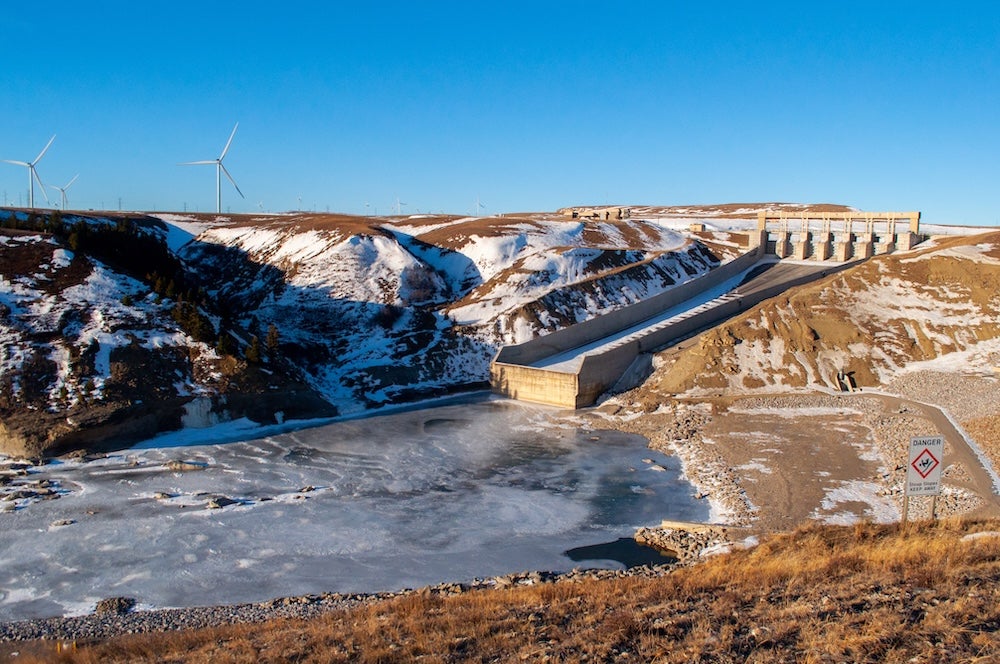
Interferometric Synthetic Aperture Radar (InSAR) is now widely recognised as a viable means to provide accurate and extensive deformation data, capable of identifying even minute ground displacements and helping to ensure dam safety. Research by Farhadiani et al has focused on the Oldman River Dam in Alberta where they claim InSAR-based deformation monitoring and prediction remain inadequately explored.
Completed in 1991, the Oldman River Dam has a crest elevation of 1125.6m asl and an operational reservoir level between 1108-1118.6m, with a maximum storage capacity of 500Mm3. As Farhadiani et al explain, the foundation of the dam is compromised by shear planes within clay shale seams, a common feature in the Western Canadian Sedimentary Basin. Instability at the dam has been potentially caused by a combination of geological features. The study introduces a novel framework for dam deformation prediction by integrating graph attention networks with the long short-term memory model (GAT-LSTM) applied to InSAR-derived deformation data from the Oldman River Dam. By addressing the limitations of prior approaches, the authors say the proposed GAT-LSTM model captures spatial and temporal dynamics of deformation across the entire study area, enhancing predictive accuracy for operational monitoring.
The InSAR analysis revealed consistent subsidence along the crest of the Oldman River Dam, with maximum semi-vertical subsidence rates ranging from 5.08 to 6.23mm/yr across three Sentinel-1 passes.
Farhadiani et al say their findings would have significant implications for dam safety and infrastructure monitoring, particularly in the Canadian context where InSAR-based studies remain limited. Furthermore, the GAT-LSTM framework can provide a reliable tool for short-term forecasting (such as 36-day horizons), which aligns with operational planning cycles and minimises error accumulation, making it actionable for dam management.
Forging new paths
“Canada’s hydropower facilities operate for generations, and the relationships that support them must be built with the same long-term perspective,” WaterPower Canada’s Lorena Patterson said at the launch of a new report in June 2026. Paths Forward: Indigenous Partnership Pathways in Canadian Hydropower, explores how Indigenous partnerships are evolving across Canada’s hydropower sector. Through stories of ownership, procurement, workforce development, and stewardship, the report highlights how Indigenous Nations and communities are increasingly participating in energy development as owners, employers, business partners, environmental stewards, and decision-makers. They reflect a shift toward partnership models that create opportunities for communities to influence, benefit from, and help guide energy development over the long term. As WaterPower Canada highlights, meaningful partnerships take time to build, extend beyond project delivery, and create benefits that reach beyond infrastructure itself.
Many of the examples featured in Paths Forward support broader community priorities, including skills development, local business growth, cultural revitalisation, environmental stewardship, and long-term economic participation. Writing in the foreword to the report, James Jenkins, Executive Director, and Chris Henderson, Founding Executive Director of Indigenous Clean Energy say: ‘The past one hundred years have seen incredible development of projects that have powered the country’s economy. Yet the story from the perspective of Indigenous communities has often been one of loss, dispossession, and profound impacts, with relatively few benefits.
“From environmental contamination to relocation of long-established communities, Indigenous communities have borne significant costs while receiving only a small share of the benefits that helped to power Canada’s industrial growth. Thankfully,” they add, “this narrative has begun to change.”
As WaterPower Canada shows in its report, Indigenous-led waterpower development and ownership are helping advance the process of reconciliation. One such example has been developed outside Ontario Power Generation’s (OPG) Saunders Hydro Dam Visitor Centre, where a garden asks visitors to slow down and connect with local ecology and Indigenous traditional knowledge. Explaining that it didn’t begin as a garden, OPG says it was more of a question about reconciliation -and what this might look like in a place where a hydroelectric station has shaped the landscape for generations.
From this grew a community space that honours local Indigenous culture by thoughtfully integrating culturally significant elements and educational features. The result is an outdoor learning environment with interpretive features designed to encourage reflection, deepen understanding and spark curiosity.
OPG developed the Saunders Hydro Dam Visitor Centre garden through a partnership with the Iroquois Sullivan Joint Venture – a collaboration between Iroquois Consulting Group, an Akwesasne-based business and M. Sullivan & Son Limited. A significant portion of the work was completed by local Indigenous subcontractors. Plant selection was developed in close collaboration with representatives from the Akwesasne community to ensure the chosen species were appropriate for the local landscape and meaningful to Indigenous cultural teachings Supporting cultural visibility, education, and community engagement matters as much as the economic outcomes on the journey towards reconciliation, OPG says. Furthermore, the Saunders Hydro Dam Visitor Centre garden helps create meaningful conversations about why environmental stewardship is essential to OPG’s operations and inspiring the next generation to carry that legacy forward.


