

Ocean energy is a vast global resource with the potential to follow a credible pathway to large-scale deployment. And it’s the ability to generate a source of renewable energy at such scale that will enable it to help wind and solar decarbonise power systems across the world. Together, wave and tidal energy have an estimated generation potential of around 3910TWh per year. This is equivalent to about 13% of present-day global electricity demand and close to the amount generated by hydropower worldwide.
Reflecting the sector’s growing potential and maturity, for the first time, the International Renewable Energy Agency (IRENA) recently included a dedicated assessment of ocean energy in its flagship report on the cost of renewable power. And as Ocean Energy Europe explained in its recent global resource assessment, beyond its scale, ocean energy also adds system value.
Being governed by the moon and the sun makes tides highly predictable, which means tidal turbines can generate for at least 20 hours per day. And when combined with short-duration battery storage, tidal power can provide round-the-clock renewable generation. Although primarily driven by wind, wave energy can also generate power for several hours after the wind has dropped. Such attributes matter to economic assessments of energy resources, according to IRENA, because the value of generation not only depends on cost but also on timing and predictability.
With wave and tidal energy moving towards commercial deployment, they look set to follow the same cost-reduction pathway established renewable technologies have. Like offshore wind before them, wave and tidal now need market visibility to unlock investment, accelerate deployment and reduce costs through scale.
IRENA reports that at an equivalent stage of development, today’s wave and tidal costs are already lower than those of other renewable technologies at the same point in their commercial journey. As deployment increases, costs are projected to continue falling to around US$120/MWh for wave energy and US$140/MWh for tidal stream once 2GW has been deployed.
Along with lower financing costs, ocean energy technology is expected to benefit from the same drivers that transformed offshore wind: innovation, industrialisation, larger projects, and economies of scale. And IRENA point to two policies that can significantly speed up the roll-out of ocean energy worldwide. These are:
- Revenue support: Experience with wind and solar suggests that ring fenced mechanisms such as contracts for difference or feed-in tariffs can provide the predictable returns and market visibility that attract private investment.
- Regulatory: Most countries still lack dedicated frameworks, such as standardised permitting, grid-connection procedures and designated deployment zones. This creates uncertainty which can slow projects and raise capital costs.
“Market visibility drives investment, deployment and cost reductions,” says Valentin Dupont, Policy Director at Ocean Energy Europe. “This virtuous cycle brought wind and solar to record levels of deployment. Ocean energy has the same business model and is set to follow a similar cost reduction trajectory with scale. National revenue support schemes are now needed to expand Europe’s pipeline of pre-commercial farms, speed up deployment and industrialise the sector.”
Current data
Known as the voice of the ocean energy industry, Ocean Energy Europe comprises over 120 organisations, including Europe’s leading utilities, industrialists and research institutes involved in this sector.
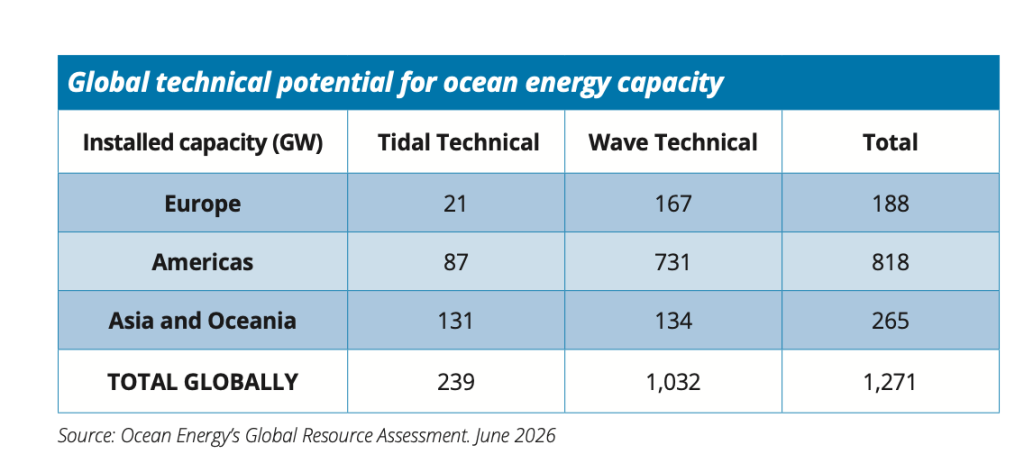
In its Global Resource Assessment published in June 2026, Ocean Energy Europe admitted its findings represent ‘a mere fraction’ of the more accurate picture of total potential. This is because their figures were only based on studies from the 20 countries that have surveyed their ocean energy resources so far.
With a substantial share of global ocean energy remaining unquantified, this means global generation potential will grow as resource assessments expand and improve – particularly across South America, Asia and Africa. Looking at current data, ocean energy has the potential to cover over 50% of electricity demand in half of the surveyed countries. These are: the UK, Ireland, Portugal, Canada, Ecuador, Chile, Indonesia, The Philippines, Australia and New Zealand. Other findings indicate that wave energy has the potential to generate more electricity than nuclear power currently does, while tidal can replace 13% of global gas generation. And looking to the future, efficiency gains will increase the energy extracted from known resources, as testing and demonstration of wave and tidal technologies continue to drive performance improvements. While the theoretical resource will remain unchanged, Ocean Energy Europe says increased technology maturity will lead to higher electricity output per device and boost overall generation potential.
Indeed, technological innovation will also help unlock new geographical resources. New or modified devices will make it possible to generate electricity from areas not yet included in current resource assessments. The report gives the example of low speed tidal current technologies can generate electricity from weaker flows (below 2m/sec) compared to conventional tidal systems. This will increase the number of viable deployment sites and overall generation potential.
Regional insight
In a geographical context, Europe leads the world in ocean energy and can supply 21% of its electricity demand. The UK and France have some of the best tidal spots in the world, making them prime locations for the first commercial farms and to industrialise the technology. By 2030, 420MW of tidal capacity is set to be installed or auctioned in the UK and France, kickstarting technical deployment across the continent. With the best wave resources in Europe can be found in the UK, Portugal, Ireland and Spain. In fact wave energy can meet over 100% of electricity demand in both Ireland and Portugal, and over 55% in the UK.
In the Americas, ocean energy can meet 36% of electricity demand, with the US and Canada having the highest surveyed potential. Wave power can meet over 20% of electricity demand in Brazil, while Chile has huge wave energy waiting to be tapped, which could provide over 300% of the country’s electricity demand.
Canada is home to the strongest tidal currents in the world. Providing up to13% of the country’s electricity demand, tidal power can generate close to what Canadian nuclear is currently providing.
And with the US Department of Energy investing US$983m in ocean energy since 2020, outstripping all European funding, it seems likely that the US could soon challenge Europe’s leadership in this sector.
Abundant resource
There are also abundant wave and tidal resources cross Asia and Oceania. Large wave resources exist across both continents, with the best potential in Australia and Japan. In fact, Australia has the highest theoretical wave energy potential on the globe and the best technical potential in Asia and Oceania, according to existing data. Tidal can meet 100% of electricity demand in the Philippines and over 50% in Indonesia, with both countries regarded as being the best location for tidal deployment in Asia. The thousands of islands between the Indian and Pacific Oceans create narrow straits that accelerate water flows, creating ideal conditions for tidal stream generation. This could be harnessed to replace coal which is the main source of fuel in the Philippines and Indonesia.
Meanwhile, increasing policy and funding support in China are helping the country to accelerate its market development of both wave and tidal power. It’s thought China may soon leverage its industrial leadership in renewables to fast-track the scale-up of ocean energy.
Despite no studies quantifying it as yet, the best ocean energy resource across Africa is expected to lie in the west and Southern areas. Several countries, including Angola, Namibia, and South Africa, show strong wave potential, while a tidal stream resource is expected to be found in the Mozambique Channel. Small Island Developing States across the Caribbean, Pacific, Atlantic, and Indian Oceans all possess considerable ocean energy potential that requires further study.
“Ocean energy is not a niche technology. The resource is abundant, the technology is progressing, and countries that move first will secure industrial leadership, export opportunities and home-grown renewable electricity. The next step is to translate this global potential into commercial deployment,” said Rémi Gruet, CEO of Ocean Energy Europe.
A pivotal time
Over the next 12 months, the Scottish tidal stream sector is reported to be facing a pivotal time, with developers looking to progress projects and fulfil its significant economic potential. But with growing demands on planning and consenting placing more pressure on regulators and key advisory bodies, it has highlighted the need for a clear and coordinated policy framework to support commercialisation of the sector.
To help build investor confidence and remove barriers which are slowing the commercial roll-out of projects, in June 2026 Scottish Renewables called upon government ministers to commit to publishing a dedicated policy statement for tidal stream technology in its upcoming Programme for Government. This would reinforce the Scottish Government’s support for tidal stream, recognising the importance of the technology and its potential to support economic growth.
“We have worked with our members to identify the biggest challenges facing the tidal stream sector and explored how these can be resolved to ensure this technology fulfils its potential to play a vital role in the UK’s future energy system,” Colin Palmer, Director of Offshore at Scottish Renewables, said. It’s vital, he added, that the sector is given the confidence it needs to accelerate the delivery of these projects.
“Scotland has a unique opportunity to capitalise on its global leadership position in tidal stream energy,” Eileen Linklater, Director of Corporate Affairs at the European Marine Energy Centre (EMEC), commented. “A clear commitment from the Scottish Government would send a powerful signal to investors that Scotland is serious about turning its world leading innovation into a globally competitive industry. We are already seeing the benefits flowing into communities through high value jobs, local supply chains and long term economic opportunities.”
Research carried out by the University of Edinburgh in 2025, shows the potential economic benefit of tidal stream energy to Scotland is £4.5bn Gross Value Added, with a further £11bn coming from international projects if the country takes advantage of its vast tidal resource. A potential 22,500 jobs could also be secured in Scotland by 2050. Tidal stream projects have already secured an 80% UK-based and 50% Scottish-based supply chain. Orbital Marine Power, MeyGen and Nova Innovation are currently developing projects, with over 300MW of generation capacity, in Pentland Firth and Orkney Waters.
Collaboration and planning
Adaptability, collaboration and evidence-based planning are highlighted as essential for reducing risk and building investor and regulatory confidence in ocean energy. And a new report published by the International Energy Agency’s Ocean Energy Systems’ (IEA-OES) Technology Collaboration Programme highlights how test centres can help accelerate ocean energy through collaboration, adaptive regulation and targeted investment
The report provides insights from over a decade of international collaboration, capturing the key findings and lessons learned to date from International WaTERS, a network of wave and tidal energy research sites established and run by EMEC.
Set up in 2013, International WaTERS aims to connect test centres, share experience and address common technical, regulatory, environmental and financial challenges. Drawing on workshops and exchanges held between 2013 and 2024, and bringing together delegates from across Europe, the Americas and Asia, the report provides a structured overview of the network’s evolution and lessons learned to inform future policy, investment and deployment. It notes how marine energy test centres have evolved from single-technology wave and tidal facilities into multi-technology innovation hubs, reflecting the sector’s response to growing technical complexity, market demand and policy priorities.
Test centres are playing a leading role in environmental monitoring, adaptive management and risk-based consenting, alongside advocating for open data sharing and standardised protocols to reduce regulatory friction. Early, transparent engagement with communities, fisheries and regulators are also seen as being central to securing social licence and building long-term trust.
“International WaTERS exists to ensure that test centres are not solving the same problems in isolation,” Dernis Mediavilla, Head of Innovation at EMEC said.
The report concludes that continued investment in shared infrastructure, knowledge exchange and coordinated action will be critical to advancing marine energy towards commercial maturity and delivering economic, environmental and social benefits worldwide. And to support future planning and strategic investment, it also provides a foundation for evidence-based policy recommendations. These aim to: advance regulatory frameworks; streamline consenting processes; strengthen stakeholder engagement; improve offshore operations; and promote data sharing.
Turning shared experience into practical guidance, Matthijs Soede, Chairman of IEA-OES, said, will help countries and stakeholders accelerate learning and lower barriers for ocean energy.
Full deployment
French wave energy technology company, Seaturns, successfully deployed its full-scale demonstrator off the Gironde estuary on the French Atlantic coast in June 2026. A first in France, it marked the commencement of a minimum 12-month offshore trial.
Under an innovative industrial collaboration, the trial period will be monitored by ESB, Ireland’s foremost energy company, providing Seaturns with an industry perspective from one of Europe’s most respected energy utilities.
The installation marks the culmination of more than ten years of research and development by the Seaturns team, representing a critical de-risking milestone on the company’s path to commercial deployment and technology certification by 2027.
Being conducted 27.5km away from Port of Le Verdon in Nouvelle-Aquitaine, within the jurisdiction of the Grand Port Maritime de Bordeaux, the location was selected for the quality and representativeness of its wave conditions relative to real offshore operating environments, whilst offering excellent logistical access for marine operations.
Primary objectives of the trial campaign are to:
- Validate the dynamic behaviour of the floater under real sea conditions.
- Develop and refine offshore operations and maintenance procedures.
- Confirm the reliability and performance of the power take-off system.
- Collect the data required for technology certification and industrialisation.
Under this industrial collaboration, ESB will monitor the key stages of the deployment and offshore trials of Seaturns full-scale demonstrator, with access to technical data and live performance results under real operational conditions. For Seaturns, the partnership represents a significant commercial signal: ESB’s engagement reflects growing institutional appetite for wave energy as a bankable, scalable renewable technology, and reinforces the potential investment case ahead of the company’s planned fundraising round in early 2027. Both companies view this collaboration as an opportunity to accelerate the development and adoption of wave energy as a competitive and viable renewable energy source.
Floating hybrids
Floating offshore wind turbines are expanding to water of depths greater than 100m, but this is posing significant cost related challenges. Recent research has indicated that a possible solution to reduce the costs lies in the design of hybrid offshore renewables, which have the capacity to reduce the levelised cost of energy of offshore wind farms through reduction of dispatch costs and peak generation requirements. Among the range of options of hybrid renewables, the combination of wind and wave stood out.
Arredonda-Galeana et al developed the novel concept of a hybrid wind and wave floating platform to provide a minimum power base load for offshore applications. Claiming to differ from alternative hybrid wind-wave platforms and wind and wave complementarity studies, in this work, the authors proposed a novel hinged-connected hybrid platform, which is modular and scalable, in order to provide a minimum power baseload.
By considering the case of offshore PEM electrolysers, whose operational life is reduced when the power baseload drops below 20% of their rated capacity, wave power reduces the downtime in which the PEM electrolyser would have to be shut down in when only wind power is available.
The hybrid platform consists of three large pontoons connected with mechanical hinges. The downstream pontoon carries a 5MW wind turbine on deck, and the wave energy is extracted trough hinge motion. By computing numerically a power matrix for wave energy conversion, and assuming mean power production for the wind turbine, the performance of the hybrid platform is evaluated. However rather than assessing performance in terms of power variability, the research gauged it by determining periods of time when the hybrid platform meets a minimum power threshold, in periods of time of absent wind power.
The platform was assessed in three locations with different wind-wave correlation characteristics off the coast of Spain, and on the West and East coast of Scotland. It was discovered that the platform has better performance in locations with high wave power density and low to intermediate wind-wave correlation indices.
The authors add that future research could include:
- Improving pontoon design to prevent water slamming and water on deck due to low freeboard.
- Performing a time-domain analysis to understand the effects of transient wind and wave loading on fatigue life and power performance of the hybrid platform.
- Expanding the numerical model to account for mooring line forces and viscous losses.
- Optimising pontoon geometry for wave power capture.
- Assessing passive yaw capabilities of the platform.
References
Renewable power generation costs in 2025. International Renewable Energy Agency (2026) Abu Dhabi.
Ocean Energy: The largest untapped renewable resource. Global Resource Assessment June 2026. Ocean Energy Europe.
A hybrid floating wind-wave energy platform for minimum power baseload by Abel Arredondo-Galeana, Gabrie,l Thomas Scarlett, Maurizio Collu, Feargal Brennan. Ocean Engineering 343 (2026) 123090 .


