

Downstream fish passage at hydropower plants is often treated primarily as an engineering question. Yet the performance of a passage system depends on more than the design and safety of its bypass, spill route or other alternative to turbine passage.
Fish responses to intake flows, route location and changing hydraulic conditions can all influence whether they reach and use the intended passage option. Evidence from three telemetry studies shows how examining these factors separately can help operators and designers identify the cause of poor performance and target mitigation more effectively.
Diagnosing the passage system
A safe bypass, spill route or other downstream passage option is an essential component, but it does not by itself create an effective system.
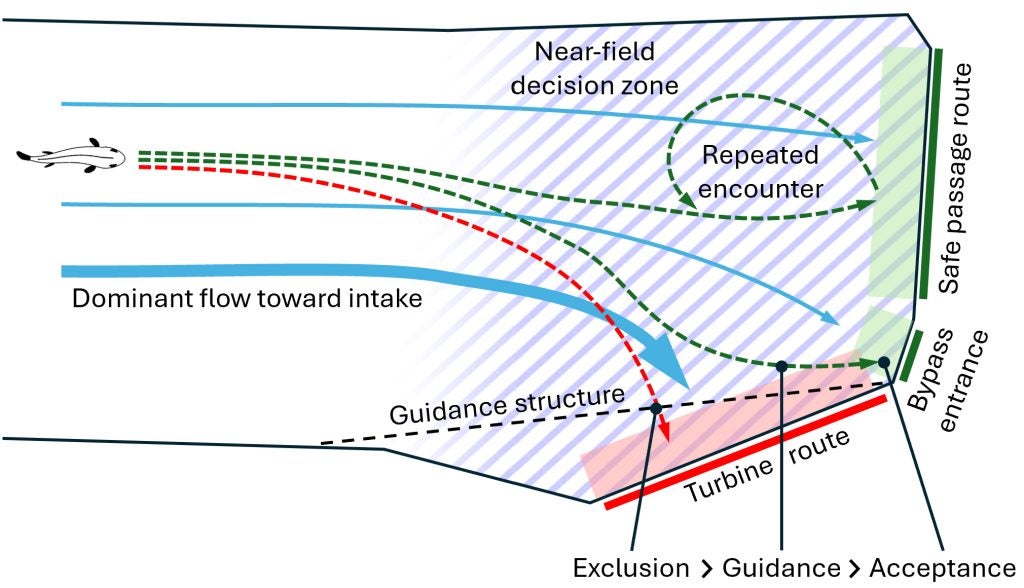
Fish must encounter the route within a hydraulically structured near-field. The dominant flow often leads towards the turbines, while safer alternatives may carry less discharge, occupy another part of the cross-section or require fish to change direction or depth.
Effective downstream passage therefore depends on three linked functions. Fish must first be excluded from hazardous routes, then guided into the part of the near-field where a safe alternative can be encountered, and finally accept and use that route when they reach it (figure 1). Failure in any one of these functions can limit the performance of the entire system.
Why simple assumptions break down
Several common assumptions can obscure which part of the passage system is limiting performance. Three were repeatedly challenged in full-scale studies of European silver eels, Atlantic salmon smolts and post-spawning brown trout kelts.
Each species has a predictable migration depth
A common simplification is that salmon smolts and trout kelts migrate close to the surface, while eels remain near the bed. These rules of thumb can provide a useful starting point, but they are too broad to form the sole basis for passage design. Across the three studies, vertical position varied not only between species and life stages, but also according to discharge, time of day, direction of movement and individual behaviour.
The practical implication is clear: a measure operating within only one layer of the water column may fail to intercept a substantial proportion of the migrating population. A surface guidance structure may therefore perform very effectively for the fish that encounter it, yet have a limited population-level effect if many individuals pass beneath it.
If fish find the safe route, they will use it
Another common assumption is that high levels of fish activity near an outlet indicate that it is performing well. This is not necessarily the case. Fish may repeatedly approach or remain close to an outlet without passing through it. A route can therefore attract considerable activity while achieving relatively little passage. This distinction is particularly important at facilities with several competing outlets. One sector may receive frequent visits but have a low probability of passage, while another may be encountered less often but readily used when fish arrive.
The key question is therefore not simply whether fish reach an opening, but whether its local hydraulic and geometric conditions provide a sufficiently clear and acceptable passage route.
One well-performing component means a well-performing system
The third misconception is that individual measures can be assessed in isolation. A rack may guide fish efficiently. A bypass may provide adequate capacity. A spillway may offer safe hydraulic conditions. Nevertheless, overall downstream passage can remain poor.
System performance depends on how these components interact. A guidance barrier may work effectively for fish that encounter it while allowing deeper-swimming individuals to pass underneath. Similarly, a safe outlet may be readily accepted when encountered but make little contribution if few fish are guided into its zone of influence. The relevant unit of assessment is therefore the complete passage system, rather than any individual structure.
Three questions for diagnosing the problem
These findings point to a more useful way of diagnosing passage performance. Instead of asking whether a measure works, three separate questions should be considered:
- Are fish adequately excluded from the hazardous route? If not, the principal bottleneck is exclusion.
- Are fish guided into the zone where they can encounter the safe route? If not, the principal bottleneck is guidance.
- Do fish use the safe route once they reach it? If not, the principal bottleneck is acceptance.
These are not alternative forms of mitigation, but linked functions that must operate together for downstream passage to succeed.
Exclusion, guidance and acceptance therefore provide a straightforward diagnostic framework. They replace the broad question Does the measure work? with a more useful one: Where does the passage process break down?
The three full-scale studies demonstrate why making this distinction matters.
Herting: good protection does not solve everything
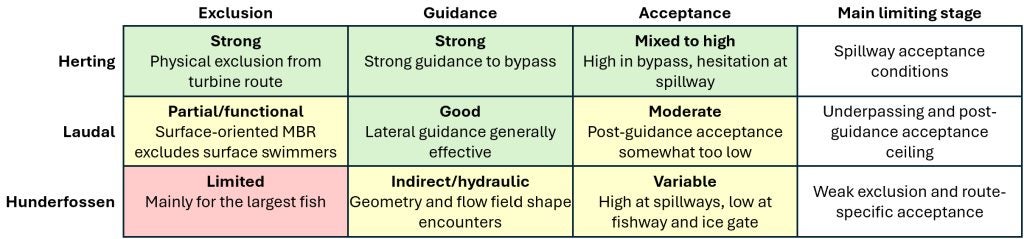
At Herting on Sweden’s River Ätran, downstream-migrating silver eels encountered a modern passage system comprising an angled, fish-tight rack that guided them towards a bypass, alongside other safe routes. Protection against turbine passage was very high, indicating that the primary exclusion problem had largely been addressed.
Telemetry data showed, however, that effective protection did not result in straightforward passage behaviour. Eels searched along the rack and sometimes hesitated at openings before passing, particularly at the separate spill outlet.
Once turbine exposure has been largely eliminated, the principal bottleneck can therefore shift. The key question is no longer whether fish are protected from the turbines, but how readily they accept and use the available safe routes. Herting demonstrates that even a highly protective system can retain local bottlenecks related to route acceptance.
Laudal: guidance helps little if fish pass underneath
At Laudal on Norway’s River Mandalselva, Atlantic salmon smolts were studied at a floating guidance structure intended to divert fish away from the hydropower intake and towards the downstream river. The guidance principle worked well for fish travelling within the surface layer intercepted by the structure. However, a substantial proportion of the smolts travelled below the depth of the barrier
and passed underneath it without meaningful interaction.
This distinction is important. Showing that a structure effectively guides fish that encounter it does not demonstrate that it will achieve high effectiveness across the migrating population.
The Laudal case therefore illustrates how guidance can perform well locally while overall results remain constrained by incomplete vertical coverage and by what happens after fish enter the intended downstream corridor.
Hunderfossen: interaction is not passage
At Hunderfossen on Norway’s River Gudbrandsdalslågen, post-spawning brown trout kelts encountered a very different passage system. The forebay contained several competing outlets, including hydropower intakes, an ice gate, a fishway and multiple spill gates. No dedicated structure directed fish towards a single, clearly defined downstream corridor.
Instead, fish moved through a large and complex forebay, often remaining there for considerable periods and interacting repeatedly with different outlets. The clearest finding was that the outlets visited most frequently did not necessarily have the highest probability of passage. Some sectors attracted considerable fish activity but achieved relatively little passage. Other outlets were encountered less often but were much more likely to be used once fish reached them.
Hunderfossen therefore highlights the difference between interaction and acceptance. Observing fish near an outlet does not establish that it provides an effective passage route.
Figure 2 identifies the dominant bottleneck within each of the three systems, whether exclusion, guidance or acceptance.
What this means for hydropower owners and designers
For hydropower owners, consultants and regulators, the practical implication is clear: identify the limiting function before selecting, modifying or investing in a passage measure.
Diagnose the limiting function
An overall passage result can conceal very different functional bottlenecks. One facility may have an effective bypass but still expose too many fish to the turbine intake. Another may successfully guide fish towards a safe corridor yet underperform because they rarely use the final outlet. These situations require different interventions.
Design for uncertainty in fish depth
Where site-specific measurements are unavailable, designs should accommodate a broader vertical distribution rather than rely on a single assumed migration depth. Species-level rules of thumb can provide a useful starting point, but they should not determine the vertical extent of a measure unless supported by local evidence.
Match the investigation to the uncertainty
Not every passage problem requires an extensive telemetry study. During the early stages of an investigation, simple observations combined with an assessment of facility geometry and hydraulic conditions may be sufficient to narrow the possible causes. Where the principal uncertainty concerns local flow distribution, a relatively simple hydraulic model may provide the necessary evidence.
If fish repeatedly reach an outlet without passing, however, the uncertainty is likely to be behavioural as well as hydraulic. Targeted observations, telemetry or more detailed flow modelling may then be required.
Any increase in the level of investigation should be intended to resolve a specific uncertainty, rather than simply generate more data.
Find the right bottleneck first
The main practical value of the exclusion–guidance–acceptance framework is that it reduces the risk of improving the wrong part of a passage system. A project may invest considerable resources in refining a component that already performs reasonably well while leaving the true constraint unresolved.
Providing a safe route is therefore only the beginning. The more useful question is not simply whether a safe downstream route exists, but where
the passage process breaks down. Once that bottleneck has been identified, it becomes much easier to select an intervention that addresses the underlying problem.
About the author
Halvor Kjærås is a hydraulic engineer at Sweco Norway. His doctoral research at NTNU focused on downstream fish passage at hydropower facilities, combining ecohydraulics, telemetry and full-scale field studies.
References
Kjærås, H. et al. (2023). Three-dimensional migratory behaviour of European silver eels (Anguilla anguilla) approaching a hydropower plant. Journal of Fish Biology, 102(2), 465–478.
Kjærås, H. et al. (2025). Full scale performance evaluation of a partial-depth floating fish guidance bar rack. Ecological Engineering, 221, 107778.
Kjærås, H. et al. (2026). Search and passage are decoupled for migrating trout kelts at a multi-exit dam. River Research & Applications.
Kjærås, H. (2026). Cross-Species Insights into Downstream Fish Passage. PhD thesis, Norwegian University of Science and Technology (NTNU).


