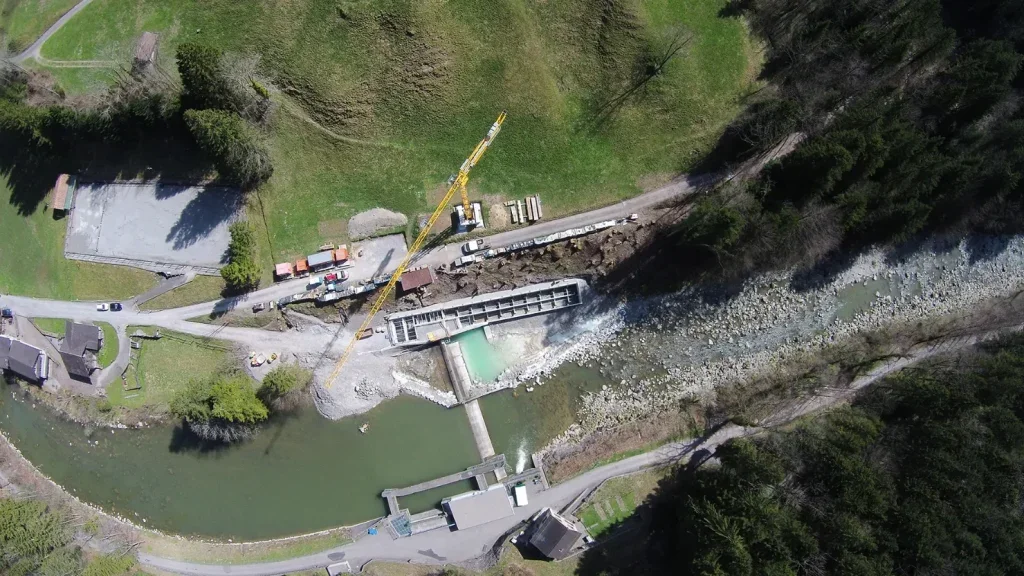

The historic Waldhalde hydropower plant on Switzerland’s Sihl River has been officially confirmed as compliant with national fish passage requirements, following the completion and validation of ecological retrofit measures.
Under amendments to the Water Protection Act and the Federal Fisheries Act introduced in 2011, Switzerland requires the restoration of free fish migration in its waterways. Hydropower operators must remediate barriers that significantly restrict fish movement by 2030. Several hundred plants nationwide are subject to the requirement.
EKZ (Elektrizitätswerke des Kantons Zürich), operator of the Waldhalde hydropower plant, began construction of fish passage measures in 2014, making it one of the first plants in the Canton of Zurich to implement the new legal provisions. The works included the installation of a fish passage facility and a bypass opening integrated into the existing weir gate. Construction was completed in 2015 and the system entered operation the same year.
The Waldhalde plant, located between Hütten and Schönenberg, was originally built in the late 19th century. It was modernized in the early 1960s and renovated in 2010, prior to the introduction of mandatory fish passage requirements. The facility generates around 14 million kWh of renewable electricity annually, equivalent to the consumption of approximately 3,000 households.
The effectiveness of the retrofit was assessed through biological monitoring. Fish counts were carried out under the supervision of an ecological consulting firm, with support from the local fishing association. At the end of 2025, authorities confirmed that fish can now pass the plant safely in both directions. As a result, the Waldhalde plant has been exempted from further remediation obligations.
The project highlights the technical and structural challenges associated with retrofitting fish passage at historic hydropower facilities, where space and existing infrastructure can limit design options.