

Across Asia and Australia, several large pumped storage hydropower projects have recently reached significant construction milestones. From high-altitude excavation breakthroughs in western China to major tunnelling progress beneath Australia’s Snowy Mountains and early works in Vietnam and Queensland, developers are pushing forward with projects designed to provide the long-duration storage increasingly required to support renewable-dominated electricity systems.
Together, the developments highlight how pumped storage is moving to the centre of energy transition strategies in many regions, with projects growing in scale, complexity and technological sophistication.
China’s Lianghekou project advances
Construction of the Lianghekou pumped storage project in western China has reached two major milestones as developers continue work on what is described as the world’s largest and highest-altitude pumped storage power station currently under construction.
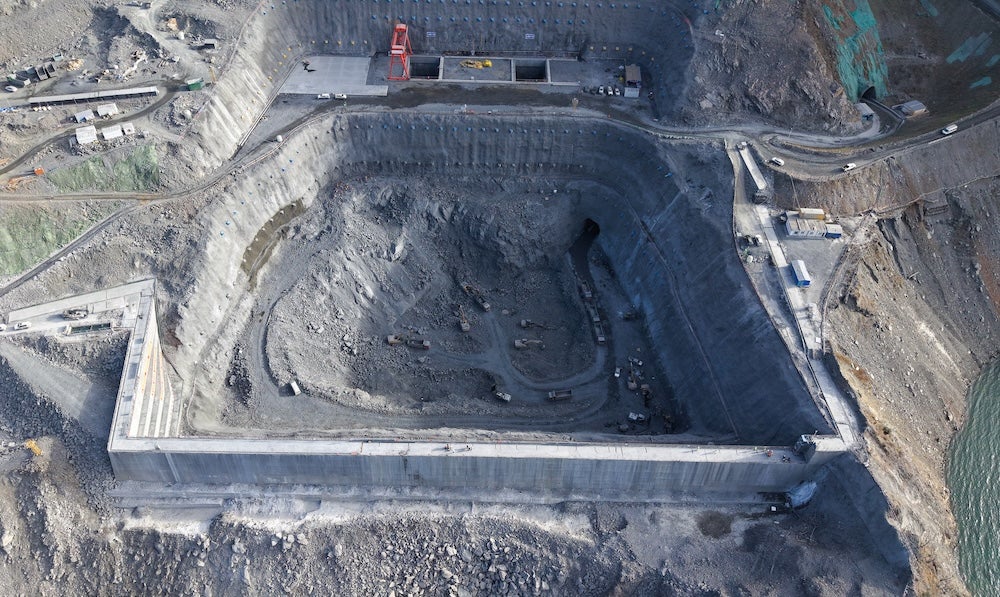
Located on the western Sichuan plateau along the Yalong River at an altitude of around 3000m, the project recently completed excavation of its underground powerhouse while also initiating the first concrete pour for the dam of the Yagen I hydropower station, which will serve as the scheme’s lower reservoir.
The Lianghekou pumped storage project utilises the existing Lianghekou reservoir as its upper reservoir and the planned Yagen I reservoir as its lower basin. The scheme will install four 300MW reversible pump-turbine units. When combined with the 3000MW of conventional hydropower capacity already operating at Lianghekou, the integrated facility will have a total installed capacity of 4200MW.
The underground powerhouse represents one of the project’s most technically demanding structures. Positioned roughly 500m beneath the surface, the cavern complex measures nearly 200m in length and around 60m in height, with a maximum excavation depth of approximately 650m. Completion of excavation marks the end of the main civil works phase and allows the project to transition to electromechanical installation.
Constructing such a large underground facility in a high-altitude environment has presented numerous engineering challenges. Workers have faced low oxygen levels, high in-situ rock stress and fractured geological formations typical of the mountainous terrain of western Sichuan. To manage these conditions, project developers deployed a self-developed intelligent construction management platform that integrates building information modelling (BIM), three-dimensional laser scanning, intelligent drilling and blasting systems, and automated ventilation controls.
A layered excavation strategy combining pre-splitting and smooth blasting techniques was adopted to maintain cavern stability. In addition, real-time deformation monitoring systems were installed to continuously track surrounding rock conditions and allow excavation and support activities to proceed simultaneously. Construction activity continued through the Lunar New Year period to take advantage of favourable dry-season conditions. During the Spring Festival, more than 500 workers remained on site operating around the clock. The project also utilised a domestically developed unmanned intelligent rock drilling rig capable of automated positioning and coordinated multi-arm drilling. Developers reported that the technology increased excavation efficiency by more than 30% and enabled the cavern excavation to be completed three months ahead of schedule.
Once operational, the pumped storage station is expected to generate approximately 1.4TWh of electricity annually while providing peak-shaving and grid-balancing services for around 7GW of wind and solar capacity in western Sichuan.
Yagen I dam construction begins
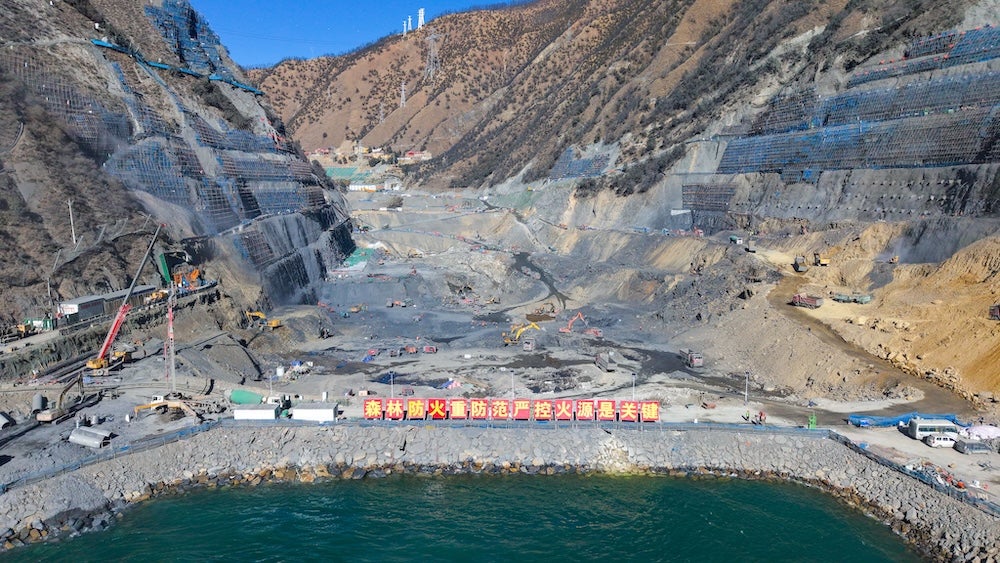
On the same day that the powerhouse excavation milestone was reached, construction teams completed the first concrete pour for the dam of the Yagen I hydropower station, a 300MW facility that forms part of the “One Reservoir, Seven Levels” cascade development on the middle reaches of the Yalong River.
The project features what developers describe as China’s widest single-sluice dam section, with an individual block measuring 47m in length. The spillway bottom slab has been integrated into a highly rigid structural design intended to improve seismic performance in the region’s complex geological environment. High-altitude winter conditions have created additional challenges during construction. Large temperature variations and complex aggregate characteristics have increased the risk of thermal cracking in the concrete, particularly in the ultra-wide dam sections.
To address these issues, the construction team implemented a full-process temperature control system covering aggregate heating, controlled mixing temperatures, insulated transport and monitored curing.
Steam curing and enclosed temperature- and humidity-controlled environments were also adopted to reduce cracking risks. More than 600 workers remained on site during the holiday period to ensure the first concrete pour could proceed on schedule.
Once completed, Yagen I is expected to generate about 1.15TWh of electricity annually. Developers estimate the plant will save approximately 350,000 tonnes of standard coal each year and reduce carbon dioxide emissions by around 940,000 tonnes.
In addition to power generation, the reservoir will function as the lower basin for the Lianghekou pumped storage station. The Lianghekou project forms part of the Yalong River Basin integrated hydropower, wind and solar development, which has been described as China’s first national-level integrated water-wind-solar power base. Within this broader initiative, the Lianghekou “Water, Wind, Solar, Storage, Hydrogen and Computing” Clean Energy Demonstration Zone is planned to have an installed capacity exceeding 50GW, accounting for about 60% of the basin’s total planned capacity.
Across the entire Yalong River integrated base, total capacity is expected to reach 78GW. Around 23GW has already been commissioned, while approximately 12GW remains under construction. Three major regulating reservoirs – Lianghekou, Jinping and Ertan – together provide a combined storage capacity of around 14.8 billion m3, enabling coordinated management of water resources and renewable energy production. According to the Yalong River Company of the State Development & Investment Corporation (SDIC), the basin aims to reach more than 40GW of operational capacity by 2030 and the full 78GW by 2035.
At that stage, annual electricity generation is projected to reach roughly 200TWh, supplying power equivalent to the annual consumption of approximately 100 million households. Developers say the Lianghekou pumped storage project will help support completion of the demonstration zone by 2028, expanding flexible capacity for large-scale renewable integration in western China while contributing to national carbon peak and carbon neutrality objectives.
Snowy 2.0 passes 70% completion
On the other side of the Asia-Pacific region, Australia’s flagship pumped storage development, the Snowy 2.0 project, has also reached an important construction milestone with the commissioning of its fourth tunnel boring machine. The TBM, named Monica after Tumut High School student and First Nations art and storytelling competition winner Monica Brimmer, was officially powered up during a ceremony attended by Australia’s Minister for Climate Change and Energy, Chris Bowen. During the event, Brimmer initiated the first rotation of the machine’s 12m cutterhead. The new TBM has been designed specifically to operate in the Snowy Mountains’ complex geology and will soon begin tunnelling from the Marica worksite near Kiandra. Its primary role will be excavating part of the project’s 17km headrace tunnel, including sections passing through the Long Plain Fault Zone, considered one of the most challenging geological areas encountered during the development.
Construction also continues across several major worksites in New South Wales. At the Lobs Hole site, nearly one kilometre underground, the focus is shifting from large-scale excavation to preparation for the fit-out of the underground power station cavern. The cavern has a footprint comparable to that of the Sydney Opera House. So far, 46 permanent concrete pours have been completed at the site.
In total, more than 733,000m3 of material have been excavated from underground caverns using drill-and-blast techniques. Several of these construction techniques build on methods originally developed during construction of the historic Snowy Mountains Scheme, one of Australia’s most iconic infrastructure projects. Another key element of the Snowy 2.0 scheme recently achieved a structural milestone with completion of the transition tunnel crown at the Tantangara intake. The structure forms the point where water from Tantangara Reservoir will enter the Snowy 2.0 system before travelling through a network of tunnels to the underground power stations located nearly one kilometre beneath the Snowy Mountains. Construction of the crown required approximately 450m3 of concrete, 160m2 of formwork and 80 tonnes of steel reinforcement. At 3.7m thick, the structure has been designed to withstand the substantial hydraulic pressures associated with large pumped storage schemes. Most of the intake infrastructure will eventually lie beneath the reservoir water level once the system becomes operational, making the completion of above-water construction a critical stage in the project schedule.
The project is being delivered by Future Generation Joint Venture as principal contractor for Snowy Hydro.
With the commissioning of the fourth TBM, overall construction progress on the Snowy 2.0 project has now surpassed the 70% completion mark.
Queensland advances Borumba investigations
In Australia’s Queensland state, development of another major pumped storage project is moving forward after receiving Commonwealth approval for exploratory works.
Queensland Hydro has obtained regulatory clearance under the Environment Protection and Biodiversity Conservation (EPBC) Act to undertake geotechnical investigations for the proposed Borumba pumped storage project. The approval allows the company to begin exploratory drilling and site investigations aimed at confirming geological conditions and reducing design uncertainty ahead of any final investment decision. Data gathered during the investigations will be used to refine the project’s detailed design and inform an updated business case. Queensland Hydro Executive Chair Mark Irwin emphasised the importance of early technical investigations for large-scale infrastructure projects.
“The Borumba Pumped Hydro Project is a critical component of Queensland’s future energy mix, and the Commonwealth regulatory approval is a significant step forward in its development,” Irwin said. “The proposed exploratory works will support the revised business case for the Borumba Project, with data collected able to support any future configuration.
“Delivering major infrastructure projects requires meticulous planning to avoid unforeseen risks. One of the most effective strategies for achieving this is undertaking comprehensive exploratory works before finalising designs and commencing future main works construction activities.”
Subject to state approvals, Queensland Hydro intends to begin the exploratory programme in 2026.
Irwin added that further approvals would be required if the project proceeds to full construction.
“In addition, and aligned to our commitments to local benefits, Queensland Hydro will be closely engaging with local suppliers and the community on the exploratory works program,” Irwin said.”
The approval follows a public consultation process conducted in early 2025, during which submissions from stakeholders were considered by the Department of Climate Change, Energy, the Environment and Water.
Conditions attached to the approval include limits on environmental disturbance, implementation of environmental management plans, land restoration requirements and compliance reporting obligations.
Vietnam’s Bac Ai project enters main construction phase
Further north in Southeast Asia, construction of Vietnam’s Bac Ai pumped storage hydropower project has also advanced ahead of schedule, enabling the development to transition into its main works phase earlier than planned. The 1200MW facility is being developed by Vietnam Electricity (EVN) in Bac Ai Tay Commune in Khanh Hoa Province and represents an investment of around VN$21.1 tn. Construction began in February 2025, with the project scheduled to commission its first generating unit in December 2029 and achieve full commercial operation by the end of 2030.
Progress and priorities for the project were recently reviewed at a coordination meeting chaired by EVN Vice President Pham Hong Phuong. The meeting brought together representatives from EVN’s Power Project Management Board No.3, the Power Engineering Consulting Joint Stock Company No.4, international consultant SSC and several major contractors.
According to the project management board, most preparatory and enabling works were successfully completed during 2025. Construction and operational access roads were connected across the site, while open excavations for major foundations were finalised. Excavation and initial support works for five adits were also completed in line with contractual schedules. Excavation and structural support for both the electrical cable tunnel and the ventilation tunnel reached full completion on 21 January 2025, exceeding the annual schedule. Earthworks for the planned 500kV switchyard platform also progressed rapidly, reaching 145,000m3 in 2025. This represents 144% of the annual target and about 90% of the total planned earthworks volume.
Road construction packages VH1, VH2 and VH3A achieved between 96 and 98% completion of their designed earthwork volumes, with the VH1 package finishing roadbed excavation and embankment works entirely. Underground works, including operation, ventilation and drainage tunnels, exceeded quarterly production targets in several sections, reaching between 104 and 117 % of planned volumes.
Procurement activities also advanced significantly. Of the project’s 32 construction and equipment packages, 28 had been awarded by the end of 2025. Land acquisition and resettlement activities covering more than 106 hectares were completed, providing full access to the main construction areas. Total capital disbursement for 2025 reached approximately VN$434.4bn, exceeding the annual budget approved by EVN.
Project managers confirmed that construction of the main underground powerhouse complex began on 22 January 2026, marking the official start of the project’s main works phase. From early 2026 onwards, construction teams will focus on critical-path activities as the project enters its peak construction period.
Environmental and social compliance remains a priority. EVN aims to secure approval for the Environmental and Social Impact Assessment and the Environmental and Social Management and Monitoring Plan by the end of March 2026, with international consultant SSC providing independent oversight of environmental, social, health and safety performance.
When completed, the Bac Ai pumped storage plant is expected to play an important role in stabilising Vietnam’s electricity system as renewable generation increases, providing peak-shaving capability, frequency regulation and reserve capacity for the grid.
Pumped storage momentum builds globally
Taken together, the recent milestones across China, Australia and Vietnam highlight the increasing momentum behind pumped storage hydropower as a cornerstone technology for energy system transformation. Large-scale storage projects are becoming essential for balancing intermittent renewable energy generation, providing grid stability and enabling deeper decarbonisation of electricity systems.
While the projects vary widely in scale and geography – from high-altitude cavern excavations in the mountains of western China to kilometre-deep tunnels beneath Australia’s Snowy Mountains – they share a common objective: delivering flexible, long-duration energy storage capable of supporting increasingly renewable power grids. As construction progresses on these flagship developments, pumped storage is poised to remain a central component of global energy infrastructure for decades to come.


