
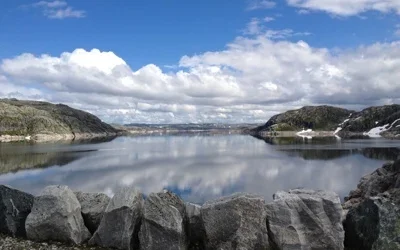
Statkraft has decided to build the Blåfjell Pump, a new facility that will transfer more water directly into Blåsjø, Norway’s largest hydropower reservoir, increasing annual electricity production at the Ulla-Førre power plants by 54 GWh.
The company has awarded four construction contracts worth a combined NOK 250m (US$26m) to contractors based in Karmøy, Suldal, Voss and Grenland. Construction work begins this week.
Blåsjø, which stretches across Ryfylke and Setesdal, is Norway’s largest reservoir by stored energy capacity and can hold water for several years, helping balance variations in water inflows between wet and dry years.
The project will draw water from three smaller lakes in Hjelmeland municipality, west of Blåsjø. The water currently flows to the lower-lying Stølsdal power plant in the Ulla-Førre system but will instead be pumped about 60 metres up to the main reservoir.
Statkraft said the change would increase electricity production in Norway’s NO2 price area by 54GWh, equivalent to the annual electricity consumption of about 2,700 Norwegian households.
“Finally, after many years of planning and adjustments, we have found a profitable way to carry out the project. Getting more water into Blåsjø is perhaps one of the most valuable things we can do for society, because the reservoir can store the water for several years and we increase generation in existing hydropower plants. In this way, significantly more energy can be generated from an already developed system, with limited additional impact on nature,” said Executive Vice President for Development in Statkraft, Pål Otto Eide.
Statkraft recently announced plans to invest NOK 80bn (about US$8.5bn) in Norwegian hydropower over the next decade, with the Blåfjell Pump project forming part of that programme.
“The Blåfjell Pump is one of many projects Statkraft is carrying out to help build and strengthen Norway. In total, our investments in the coming years represent one of the largest industrial boosts in the country,” added Eide.
The project includes a transfer tunnel, an underground pumping station and several smaller transfer structures. Total costs are estimated at around NOK 300m (US$31m), with commissioning planned for December 2027.
Alongside the pumping project, Statkraft will carry out upgrades to four dams at the western end of Blåsjø, as required by the Norwegian Water Resources and Energy Directorate (NVE). The company expects all work to be completed in 2028.
Statkraft said it split the construction work into four contracts to allow national, regional and local companies to compete for the work.
“It has been important for us to facilitate a form of competition where contractors can do what they do best, and where the contractors we also need in our day-to-day operations are able to take part in the bidding. We have noticed that there is less activity in the construction market, and competition for the contracts has been strong,” commented Tor Oxhovd Svalesen, who has led the development of the project.


