
From the Vakhsh River in Tajikistan to the Indus in Pakistan, some of the largest dam projects under construction are progressing through very different stages of development. Embankments are rising, diversion tunnels are breaking through and concrete placement systems are being prepared for structures that will support thousands of megawatts of generating capacity. For Global Hydropower Day, these five developments offer a perspective on the scale of investment in new hydropower infrastructure. They also demonstrate why progress cannot be measured by installed capacity or dam height alone. First generation, reservoir impoundment and completion of the main structure can be separated by years, with each milestone bringing its own engineering demands.
Rogun, Tajikistan
With a planned height of 335m, Rogun is intended to become the world’s tallest dam. The development on Tajikistan’s Vakhsh River combines a rockfill dam with a power station designed for six 600MW units, giving a total installed capacity of 3600MW.
Construction reached a significant milestone in August 2026 when the dam was raised to an elevation of 1155m above sea level. This elevation is distinct from the structure’s eventual height above its foundation.
The increase allows the reservoir level to rise by a further 40m to an elevation of 1140m, increasing generation from the two turbines already operating. Rogun therefore remains a major construction site while also supplying electricity.
That overlap between construction and operation is central to its development. Raising the dam does more than move the project towards its final dimensions: it enables the operating units to make greater use of the available water head.
Rogun illustrates the importance of distinguishing initial electricity production from full project completion. Its ultimate scale will emerge through successive stages of dam raising, reservoir development and installation of the remaining generating units.
Shuangjiangkou, China
On the Dadu River in Sichuan province, Shuangjiangkou is being developed around a 315m-high dam and a 2000MW power station. Its planned height would exceed the 305m Jinping-I dam, although Rogun’s ultimate design is taller still.
The start of water storage in May 2025 marked a major transition after years of construction. First generation followed on 26 June 2026, when the initial unit connected to the grid.
Generation began while substantial dam construction remained. A July 2026 update stated that the embankment had reached 260m, with a further 55m of raising required. Topping out was expected in 2027.
As at Rogun, the introduction of generating capacity is taking place before the structure reaches its final height. The development therefore brings together continuing dam construction, reservoir impoundment and power station commissioning.
Dibang, India
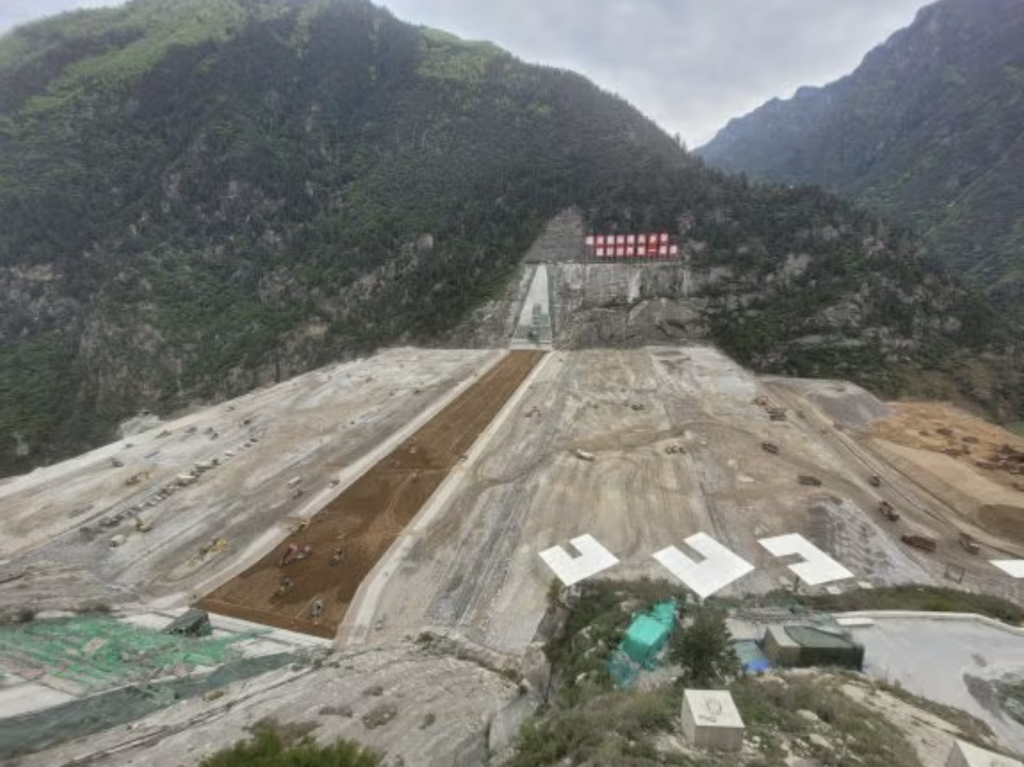
India’s Dibang Multipurpose Project in Arunachal Pradesh will combine a 278m-high concrete gravity dam with 2880MW of installed generating capacity. Located on the Dibang River in Lower Dibang Valley district, it is designed to become the country’s tallest concrete gravity dam.
The project has advanced from approval of funding for pre-investment activities in 2019 to the laying of its foundation stone in 2024 and subsequent progress on underground works. Larsen & Toubro’s construction arm has reported simultaneous breakthroughs in diversion tunnels DT-4 and DT-5.
These tunnels are an important milestone at a development whose most prominent feature will eventually be the main dam. River diversion forms part of the construction sequence needed to establish working conditions in the river channel.
The generating infrastructure is substantial in its own right. The scheme comprises twelve 240MW units, an underground powerhouse and multiple headrace and tailrace tunnels.
Dibang’s engineering scale consequently extends well beyond its dam height. Delivering the project requires coordination between the main structure, diversion works, waterways and underground generation facilities. Tunnel breakthroughs provide a tangible indication of that broader programme moving forward.
Diamer Basha, Pakistan
On Pakistan’s Indus River, Diamer Basha combines a planned 272m-high RCC arched gravity dam with 4500MW of generating capacity. Its design includes approximately 17 million cubic metres of concrete and two underground powerhouses containing twelve Francis units.
The reservoir is designed for approximately 10 billion cubic metres of total storage, including around 7.9 billion cubic metres of live storage. This gives the development a substantial water storage role alongside its generating capacity.
Recent milestones have centred on preparations for main dam construction. WAPDA announced plans to begin RCC works in early 2026, while installation of the main cable for a 30-ton cable crane across the Indus was reported in August.
The crane installation demonstrates the scale of the supporting infrastructure required before the main structure can rise. Concrete production, transport and placement must operate as a coordinated system capable of serving an enormous construction programme.
For Diamer Basha, equipment installation and construction logistics are therefore significant milestones in their own right. They establish the means of delivering the dam, as well as supporting progress towards its eventual power and storage functions.
Dasu, Pakistan
Also on the Indus, Dasu is being developed in stages towards an ultimate installed capacity of 4320MW. Stage I accounts for 2160MW, making the distinction between the initial development and the complete scheme essential to understanding its scale.
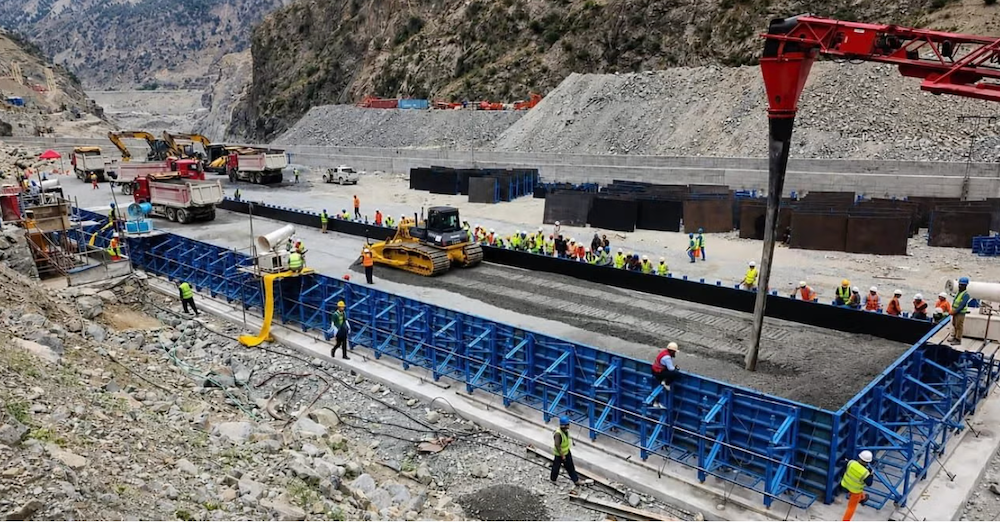
A full-scale RCC trial began in July 2026 ahead of main dam construction, marking preparation for the project’s central concrete works programme.
Dasu is consequently at a different stage from Rogun and Shuangjiangkou, where generation has begun while dam construction continues. Its recent milestone concerns readiness for main dam construction.
The Stage I equipment package includes six Francis turbines and generators supplied by GE Renewable Energy in consortium with PowerChina Zhongnan Engineering Corporation.
The staged approach divides the ultimate development into successive delivery programmes, with civil construction and generating equipment forming interdependent parts of the initial scheme.
For Global Hydropower Day, these projects highlight the sustained engineering effort behind new generating capacity. Reservoir elevations, diversion tunnels, lifting systems and concrete trials may attract less attention than headline megawatt figures, but they determine how projects advance. At each site, the next major milestone depends on completing those individual elements within a coordinated construction programme.