

Worldwide, there is currently no recognised standard or code governing the seismic design of river diversion works in dam projects, leaving a significant gap in dam engineering practice. As a result, seismic actions on temporary structures such as cofferdams and diversion facilities are frequently treated inconsistently — or ignored altogether — even in regions of high seismicity. This article examines this design deficiency by focusing specifically on the seismic design of river diversion works. Commonly adopted approaches for cofferdams and other temporary structures are reviewed and critically assessed, and a practical threshold for when seismic actions should be considered is proposed. Using peak ground acceleration interpolation from Eurocode 8 alongside probability-of-exceedance risk analysis, the seismic criteria currently applied in practice are evaluated and their associated risks quantified. The article recommends aligning seismic design criteria for temporary works with those used for flood design, and discusses the accuracy and practical limitations of the Eurocode 8 interpolation method when applied to construction-phase structures.
1. Introduction
A construction earthquake (CE) is defined as a seismic event considered specially for the design of temporary structures during the construction period. Among various temporary structures, this paper focuses primarily on river diversion works, including cofferdams, diversion tunnels, diversion channels and culverts. These structures enable for dewatering the construction site of main permanent dam, thereby temporarily creating dry land and protected working conditions throughout the construction period.
Although cofferdams are typically much smaller than the main dam and the risk exposure period is only the construction period of main dam, the potential risk to the downstream communities must not be underestimated. The temporary nature of these works shall not negate the need for rigorous engineering; rather, appropriate dam engineering principles must be applied to their design and construction to ensure safety and manage seismic risk during the construction period of main dam. This is of significance, as seismic loads can impact both the internal and external stability of cofferdams. In the case of diversion tunnels, seismic considerations are especially important for the inlet portals.
Seismic loading refers to the application of seismic oscillations on a structure and constitutes a primary load consideration for hydraulic structures. Bulletin 148 of the International Commission on Large Dams (ICOLD) [1] states:
“For critical construction phases and temporary structures such as cofferdams, retaining structures etc. it is also necessary to check the earthquake safety. The return period of such earthquakes depends on the type of structure, the duration of its use or the duration and seismic vulnerability of the structure during critical construction stages and the consequences of its failure”.
Liu et al. [2] demonstrated that a construction earthquake could severely affect a cofferdam in a high seismicity region, potentially compromising its stability and serviceability. Huang and Liu [3] reported severe damage to temporary works at Upper Trishuli-3A hydropower project in Nepal during the 2015 Gorkha earthquake (magnitude of 7.8), which occurred while the project was under construction. The dam site is located approximately 70 km from the epicentre.
At present, there is no international standard specially addressing the seismic design of river diversion works, leaving fundamental question unanswered, such as when to consider construction earthquakes and how to define appropriate design parameters, which has been perplexing dam engineers. In practice, the absence of national and international standards has led to diverse criteria and project-specific approaches, resulting in inconsistent design quality and varying levels of seismic risk management for temporary works.
To bridge this design gap, the Author aims to address the problem, bring attention to overlooked issue and offer a preliminary framework. This paper proposes design criteria which may serve as a useful starting point for consistent and robust seismic design of temporary river diversion structures.
2. Challenges associated with seismic design of temporary works
It is well known that the design of temporary works differs significantly from that of permanent works. These differences must be considered when formulating design methods and selecting design parameters.
- Shorter Service Life: Temporary works typically have much shorter service lives than permanent works. For instance, a cofferdam usually serves for 3 to 5 years, whereas the prescribed lifespan of a main dam is 100 years. It is very rare for a cofferdam to maintain in use for 8 to 10 years. Consequently, exposure of cofferdams to earthquake events is less than for permanent structures.
- Limited Impact on Permanent Structures: Failure of temporary works may delay the construction schedule, but not necessarily compromise the integrity of permanent structures such as concrete dams.
- Controlled Use: Temporary works are used within controlled construction sites for the project construction and are not accessible to the public. Cofferdams being lower in height than main dams, are often subject to lower performance expectations under seismic conditions.
These factors likely contribute to the lack of relevant standards/codes associated for seismic design of temporary works. Some standard even suggests that “As cofferdams are temporary structures, generally earthquake factor need not be considered in the designs”[4]. However, this mindset poses several challenges at least on the following counts:
- Lack of Awareness: Contractors and clients may be unaware of the need for seismic design in temporary works, leading to seismic risks being overlooked or underestimated. Allowances of seismic design for temporary works may not be included in tender documents.
- Limited Focus during Design: Designers of permanent works may account for construction methodology but often give little attention to the seismic resilience during the construction phase.
- Responsibility Delegated to Contractor: In most of dam and hydropower projects, the design, construction and operation of temporary works are the sole responsibility of the contractor. The capacity of components is often quantified by contractor’s in-house analysis and testing, with seismic loading frequently omitted from design, detailing, and testing processes.
- Cost-Driven Omission: Contractors may neglect seismic requirements for the temporary structures to minimize project costs and shorten construction timeline. The supervision of temporary works is often perfunctory, further compounding the issue.
- Lack of Seismic Monitoring: While permanent structures are subject to rigorous seismic monitoring, there is little to no observation of performance of temporary works during earthquake events. This absence of monitoring work makes it difficult to improve the seismic design of such structures.
Despite their temporary nature, cofferdams are water retaining structures and thus relevant to public safety. A lot of cofferdams are 15 m or higher – some even approaching 100 m, which can be classified as large dams according to the World Register of Dams of ICOLD. Cofferdams may encounter earthquakes, causing damage or collapse and thus posing risk to public safety. Cofferdam failures may cause loss of life among downstream residents and construction personnel, significant property damage and construction delays. This is particularly critical for cofferdams with long service lives, or a failure could lead to severe consequences. In such cases, the design should be based on longer return periods to ensure sufficient resilience.
3. Review of seismic design practices for temporary works
As indicated above, there are no consistent international standards regulating the seismic design of cofferdams and other temporary works in dam projects. As a result, the seismic design of temporary works is typically addressed on a project-by-project basis. In the following, the commonly adopted design practices are briefly summarized.
3.1 Non-consideration of seismic action
In many cases, seismic actions are not considered in the design due to the short service life of temporary works. In the most extreme instances, earthquake effects are entirely disregarded [4]. However, this approach is, after all, inconsistent with ICOLD guidelines [1] and not unanimously accepted within the professional community.
From a practical standpoint, the omission of seismic effects may be accepted for cofferdams and other temporary works located in regions of low to moderate seismicity. However, this approach is not suitable for projects situated in areas of high seismicity. In such cases, earthquake actions must not be ignored under any circumstances.
For temporary works located in high seismicity regions, especially cofferdams, seismic risk shall be addressed in the design, because these temporary structures are not only associated with potential property loss but, more importantly pose risk to public safety. Accordingly, structural measures should be taken to enhance their stability and resilience against seismic actions.
To this end, it is advisable to establish a threshold that defines when seismic actions should be considered. This proposal will be presented in Chapter 4.
3.2 Seismic design using the same criteria as for flood design
Martin Wieland [5, 6, 7] suggested that “the CE is to be used for the design of temporary structures and river diversion facilities such as cofferdams, diversion tunnels and intake. The return period of the ground motion parameters of the CE of diversion facilities may be taken as that of the design flood of the river diversion”.
In engineering practice, floods with return periods of 25 and 50 years are typically used for the hydrological design of cofferdams and other diversion facilities during the construction of large concrete and embankment dams (main dams), respectively. These return periods can also be applied to seismic design. In our opinion, using the same return periods for both the hydrological and seismic design of temporary works is reasonable and logical. Therefore, we support this approach.
It should be noted that project-specific Seismic Hazard Assessments (SHA) typically provide PGA values of operating basis earthquake (OBE), design basis earthquake (DBE) and safety evaluation earthquake (SEE), while PGA values for other return periods are usually not available. To overcome this limitation, the interpolation method presented in Eurocode 8 (EN 1998) [8] may be used to calculate the required PGA at the prescribed return period from the given PGA values. The details of the method are presented and discussed in Chapter 5 of this paper.
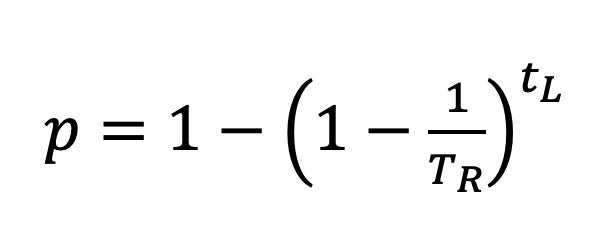
Furthermore, the risk associated with return periods of 25 and 50 years for main concrete and embankment dams, respectively, can be calculated using Eq. (A-1) in Appendix-1, expressed as probability of exceedance, as listed in Table 1.
Table 1: Risk Analysis
| Return period (TR, year) | Service life (tL, year) | Probability of exceedance (p, %) |
| 25 | 3 | 11.53 |
| 5 | 18.46 | |
| 50 | 3 | 5.88 |
| 5 | 9.61 |
For the construction of large concrete dams, a probability of exceedance below 20% is considered acceptable, given that concrete dams are generally perceived to be more resistant to overtopping failure. For embankment dams, a probability of exceedance up to 10% is considered reasonable due to their great susceptibility to erosion during overtopping flows, which can lead to the loss of completed portion of the dam body.
3.3 Seismic design using 0.5 times the PGA value for OBE
In design practice, it is frequently observed that some designers adopt a PGA value equal to 0.5 times the PGA value for OBE as the construction earthquake. To our knowledge, this method is not founded on a sound engineering principles but rather serves as a rule-of-thumb.
According to ICOLD recommendations, the return period of the OBE is 145 years. Using Eq. (3) the corresponding return period associated with can be calculated (let k=3) as follows:
Solving this equation gives a return period of TL=18 years. If the service life of the temporary facilities is 3 years or less, the probability of exceedance using this method is p=15.66%. This level of risk may be acceptable for the construction of main concrete dams. However, for embankment dams, this criterion may be overly optimistic and could lead to inappropriate decision-making due to the higher vulnerability of embankment dams to overtopping damage.
3.4 Seismic design using 0.5 times the PGA value for DBE
As one more way, some designers consider using a PGA equal to 0.5 times the PGA for DBE as the construction earthquake. This method is an approximate treatment in design and generally considered as a rule-of-thumb, but more conservative than the method described in Section 3.3 above.
According to ICOLD recommendations, the return period of the DBE is 475 years. Using Eq. (3) and setting k=3, the corresponding return period for can be determined as follows:
Thus, the return period is TL=59 year. Even with a service life of 5 years, the corresponding probability of exceedance using this method is p=8.14%. Viewed this way, this conservative criterion is acceptable for both concrete and embankment dams.
4. Threshold for starting consideration of seismic action
As described in Section 3.1, completely disregarding seismic action is not appropriate. To provide a more structured and quantifiable basis for this, we propose establishing a threshold value to guide when seismic action should be considered.
It is recognised that, even in the absence of explicit seismic design, structures including cofferdams and other temporary works designed and constructed under the modern technology are typically capable of withstanding earthquake shaking up to a level of Richter Magnitude 5.0 or Modified Mercalli Intensity MMI=VI with no damage or with only negligible damage. This level of seismic intensity approximately corresponds to a PGA=0.10g, where g is the gravity of Earth. Therefore, we propose PGA=0.10g as a threshold for temporary structures, in alignment with the respective return periods described in Section 3.2.
The threshold essentially represents a non-damage or slight-damage criterion. That is, if the expected PGA is below this threshold, no damage or only insignificant acceptable damage is anticipated for cofferdams and other temporary works. In such cases, seismic action may reasonably be omitted from the design consideration. We believe this threshold is just and reasonable, and we anticipate broad support from professionals in this field.
Conversely, in high seismicity regions, omitting seismic action from the design of river diversion works may compromise structural safety. Earthquake shaking exceeding the proposed threshold could damage temporary works, undermine their resilience, pose risk to human life, and lead to severe economic losses. Under such circumferences, seismic actions must be duly account for in the design.
5. Interpolation of peak ground accelerations
5.1 Formula from Eurocode 8 (EN 1998)
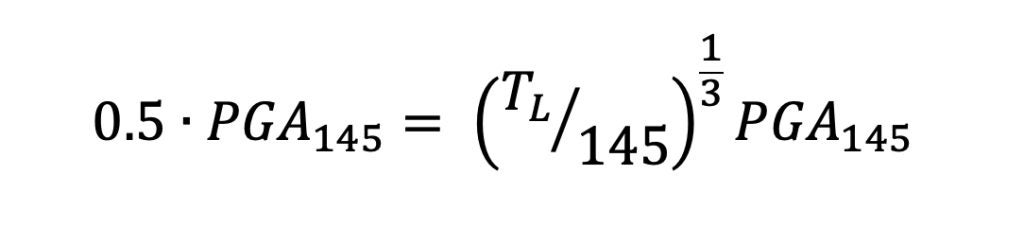
It is frequently requested to derive a specific level of the peak ground acceleration PGATL at a site in a specified return period TL, based on a known reference peak ground acceleration PGATLR with return period TLR. For this purpose, the formula provided in Clause 2.1(4) of EN 1998-1 and in Annex A of EN 1998-2 [8] can be used for both interpolation and extrapolation of PGA values. This section highlights several specific considerations in applying this formula.
At most sites, the annual rate of exceedance, H(PGATLR), of the reference peak ground acceleration PGATLR may vary with PGATLR as:
(1)
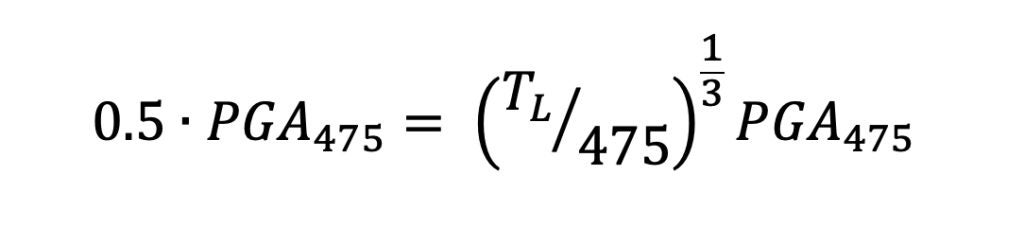
In accordance with EN 1998, when seismic action is defined in terms of the reference peak ground acceleration PGATLR, the importance factor multiplying the reference seismic action achieves the same probability of exceedance over TL years as in the same probability of exceedance in TL years as over TLR years. The relationship between PGA and the respective return periods or annual probabilities of exceedance can be expressed via the importance factor as follows:
(2)
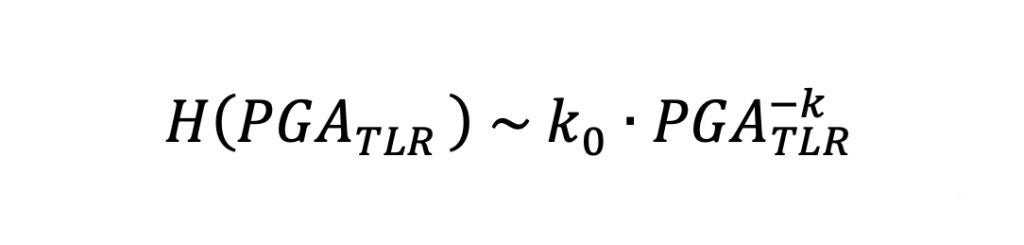
From this, the desired PGA for return period TL is calculated
(3)
in which k denotes the seismic exponent.
Equation (3) is the fundamental expression used to determine the target PGATL. Nevertheless, its application requires careful consideration of the assumptions and site-specific conditions as discussed in the following subsections.
5.2 Discussions
(1) Seismic exponent k
The seismic exponent k describes the relationship between the annual probability of exceedance (or return period) and the reference ground acceleration. It depends on seismicity and ground conditions at a specific location. A medium value of k=3 is recommended by EN 1998-1 for most sites if a more precise value cannot be determined. However, EN 1998-1 does not provide instructions on how to determine this exponent.
Bisch et al. [9] suggested a range of k=2.5 to 4, with k=3 being typical for regions of high seismicity. Lower values of k correspond to regions of low seismicity. Dragojevic et al. [10] indicated that k may be as low as 2 or less in low seismicity regions.
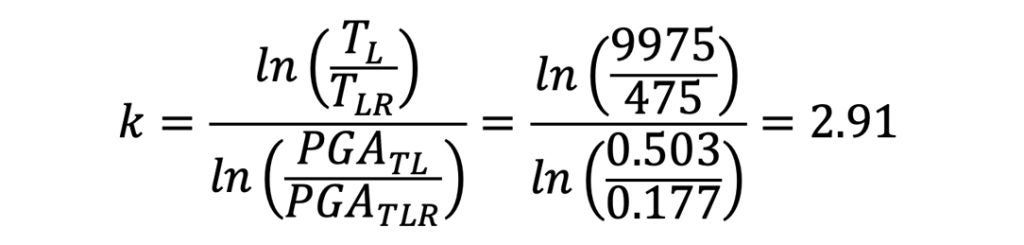
In our opinion, using k=3 is appropriate for determining the construction earthquakes (CE), especially since CE is primarily considered in high seismicity regions. Nevertheless, if two credible PGA values corresponding to distinct return periods are available (which are supported by a seismic hazard assessment – SHA), the k-value can be calibrated in an engineering-based approach. As an example, a SHA for a large dam project yielded the following seismic parameters:
• Design Basis Earthquake (DBE) with a 475-year return period: PGADBE=0.177 g
• Safety Evaluation Earthquake (SEE) with a 9975-year return period: PGASEE=0.503 g
Substituting the parameters into Eq. (3), it comes out:
(2). Interpolation and extrapolation
In principle, interpolation of an expected PGA for lower return periods from known higher return periods using the formula is generally acceptable. In contrast, extrapolation from lower to higher return periods should be approached with caution.
In this regard, Stempniewski & Maltidis [11] found that equation (3) can provide satisfactory extrapolation results up to a 1400-year return period earthquake based on a 475-year event. For return periods exceeding 1400 years, they recommend conducting a site-specific seismic hazard assessment. The likely cause of errors at high return periods is that regional tectonic and geological conditions are not considered in the formula. After all, the formula cannot present the full complexity of seismology, and it is impossible to use a formula to represent all earthquakes. Therefore, the formula should be regarded as an approximation.
From a mathematical standpoint, inaccuracies in known PGA values at low return periods can be accumulated and magnified during extrapolation, potentially causing large discrepancies that render the extrapolated PGA for higher return periods unreliable or even unusable.
For the above reasons, it is not recommended to extrapolate the PGA at very high return periods (e.g. over 1500 to 2500 years) based on low return period events (e.g. 145 or 475 years).
In practice, some people extrapolate the PGA for SEE based on the PGA for OBE. This approach is flawed for two main reasons:
- First, as discussed, extrapolation from low return periods introduces significant error.
- Second, OBE in principle represents a serviceability limit state and is an economic criterion to ensure the dam against economic losses from damage or loss of service, which is relevant primarily to the dam owner, while SEE pertains to dam safety as a safety criterion and represents an ultimate limit state. Therefore, using an economic index (OBE) to extrapolate a safety index (SEE) is fundamentally incorrect.
(3). Reference earthquake parameters
As well-known, site-specific SHA is typically established for large and important projects during the construction design phase (and occasionally during tender design). For small projects or during the feasibility study phase, SHA is rarely conducted. In such cases, country’s seismic hazard maps are often used to determine reference earthquake parameters.
However, caution is needed, especially when extrapolation PGAs for high return periods, because significant errors may be hidden in the extrapolation of PGA to high return periods. The country’s seismic hazard maps generally do not account for local conditions at dam sites. Typically, these maps are intended for buildings, which are often founded on soils and designed for a DBE with a return period of 475 years. The average value of propagation velocity of shear (S) waves in the top 30 m (VS30) of soil profile used in such maps generally VS30≤750 m/s (Ground Class C and D [8]).
In contrast, most dams, especially concrete dams, are founded on sound rocks with VS30≧1000 m/s (Ground Class A and B[8]). As a result, PGAs from country’s seismic hazard maps developed for buildings on soil may be higher than those determined via SHA for dams on sound rock foundation, potentially leading to overestimation of the PGA and conservative design.
In this regard, country’s seismic hazard maps should be carefully reviewed when used for dam design on rock foundation.
(4). Challenges in fitting multiple PGA vales
A practical problem is that it is difficult to fit all data points with a single equation (Eq. 3) when more than three PGA values are provided in an SHA. This limitation should be acknowledged during the analysis.
5.3 Example of interpolation
Frequently, SHA provides the earthquake parameters for OBE, DBE and SEE for a dam project. However, the earthquake parameter for the design of cofferdams and other temporary structures, typically associated with a 50-year (or 25-year) return period, is not provided. In such cases, interpolation can be performed to determine the PGA for cofferdam design based on available PGA values, such as that of the DBE. For example,
Alternatively, using a seismic exponent k=3.0, we obtain PGA50=0.084g. In this example, the discrepancy using the two seismic exponents is minor. According to the previously proposed threshold, the seismic action can be omitted in the design of the cofferdam.
6. Conclusions and recommendations
Construction earthquakes should be properly addressed in the design of temporary works, such as cofferdams, in dam projects – not only for economic reasons but, more importantly, for public safety. For the seismic design of river diversion facilities, the following are recommended:
- The design for cofferdams and other temporary works shall consider earthquake actions and the potential consequences of failure.
- A peak ground acceleration (PGA) of 0.10g is recommended as the threshold for initiating seismic load consideration. Cofferdams designed and constructed using modern engineering practices can typically withstand earthquakes up to this level without significant damage.
- The hydrological design criteria for river diversion works may also serve as the basis for seismic design. In particular, earthquakes with return periods of 25 years for concrete dams and 50 years for embankment dams are recommended. These criteria are considered logical and reasonable.
- Risk analysis should be an integral part of the design process for temporary structures. In our opinion, a probability of exceedance of 20% for concrete dam construction and 10% for embankment dam construction is prudent and thus acceptable.
It is worthwhile mentioning that the prescribed service life of river diversion works varies by projects. The recommendations above are based on a service life of 3 to 5 years. If the actual service life is shorter or longer, the seismic design criteria should be adjusted accordingly.
References
[1] ICOLD, (2016), “Selecting Seismic Parameters for Large Dams Guidelines” Bulletin 148, Committee on Seismic Aspects of Dam Design, International Commission on Large Dams [2] X.S. Liu, M. Li, L.J. Zhang, D.C. Chen, X. Yang and Y. Li (2021), “Seismic Response of the Rock-filled Cofferdam Slope under Earthquake Conditions Considering Hydraulic-mechanical Coupling Effect”, 11th Conference of Asian Rock Mechanics Society,Earth and Environmental Science,Vol. 861, 21-25. 10. 2021, Beijing, China, doi:10.1088/1755-1315/861/7/072096 [3] Y. Huang and J. L. Liu (2017), “Seismic performance of hydropower plant and highway system during the 2015 Gorkha Earthquake in Nepal”, 16th World Conference on Earthquake, 16WCEE 2017, Santiago Chile, January 9th to 13th 2017, Paper No.2925 [4] IS 10084-1 (1982): Criteria for design of diversion works, Part 1: Cofferdams [5] M. Wieland (2007), “Seismic aspects of safety relevant hydro-mechanical and electro-mechanical elements of large storage dams”, The Annual Meeting of International Commission on Large Dams, Prague, Czech Republic, 3-7 July 2017 [6] M. Wieland (2004), „Design criteria“, International Water Power & Dam Construction, Vol 56, No. 6, pp 26-29 [7] M. Wieland (2014), “Seismic Hazard and Seismic Design and Safety Aspects of Large Dam Projects”, Second European Conference on Earthquake Engineering and Seismology, Istanbul, Turkey, 25-29 August 2014 [8] EN 1998 (Eurocode 8), “Design of Structures for Earthquake Resistance”, Part 1, “General rules – seismic actions and rules for buildings”, 2004; Part 2, “Bridge”, 2005 [9] P. Bisch et al. (2011) “Eurocode 8: Seismic Design of Buildings Worked Examples”, Workshop EC 8: Seismic Design of Buildings, Lisbon, 10-11 Feb. 2011 [10] D. Dragojevic, R. Salic and Z. Milutinovic (2013), Analysis of Exponent K Based on “Share” Project Data and Its Implications on Importance Factors of EN 1998-1”, Research Square, DOI: https://doi.org/10.21203/rs.3.rs-746902/v1 [11] L. Stempniewski & G. Maltidis (2012), “Seismic actions for waterways engineering” (in German), Conference Proceedings of Eurocodes for Waterways Engineering, 8-9. 10.2012 in Karlsruhe, Germany, pp 65-71 [12] Z. Wang & L. Ormsbee (2005), “Comparison Between Probabilistic Seismic Hazard Analysis and Flood Frequency Analysis”, EOS, Transactions, American Geophysical Union, Vol. 86, No. 5, pp 45, 51-52Appendix-1: Probability of Exceedance
Mathematically, a risk analysis can be conducted in terms of the probability of exceedance (p) based on the adopted return period (TR) for the earthquake event and the service life (tL) of the diversion structures. According to Zhang & Ormsbee [12] and Annex A of EN 1998-2 [8], the probability of exceedance can be expressed using a Poisson probability distribution as:
(A-1)
In this context, the reference seismic action corresponds to an important factor .
Chongjiang Du is a key expert in dam engineering with Lahmeyer International Ltd., Germany. He received his bachelor’s degree in civil engineering from Dalian University of Technology, China, and his master’s degree from Tsinghua University, China. He worked as an assistant professor at the Karlsruhe Institute of Technology (former University of Karlsruhe), Germany, where he was awarded his Dr.-Ing. title. He started his career in 1982 with more than 40 years of experience as a designer and consultant in dam engineering, specializing in concrete dams and concrete technology, including conventional concrete and RCC dams. He is also one of the primary authors of ICOLD Bulletin 177, “Roller-Compacted Concrete Dams”, 2020. He was involved in design/consult, construction supervision, research and technical administration of various concrete dams. He presently works on several concrete dam projects.


