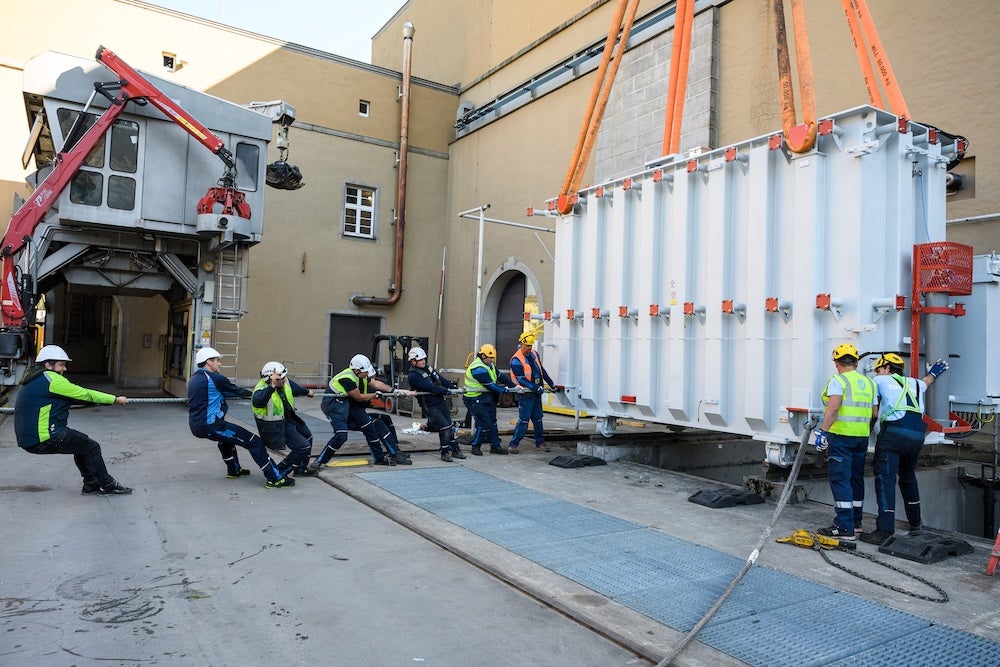

The first of five new transformers has arrived at the Jochenstein hydropower plant on the Danube at the Germany–Austria border, where VERBUND is undertaking a €61.4m modernisation programme to increase generating capacity and improve operational flexibility.
Delivered on 6 October, the 62-tonne transformer travelled to the plant via the Austrian side of the river before a VERBUND floating crane carried it across the Danube to the intake platform and lowered it into its final position.
The transport vehicle measured 30m long, 3.5m wide and 4.4m high, with the low-loader and transformer weighing approximately 122 tonnes combined. The transformer itself measures around 6.5m by 3m by 4m.
The floating crane has a maximum lifting capacity of 100 tonnes and dates back to the plant’s construction. It remains essential to lifting operations because the architecture at Jochenstein prevents the use of a gantry crane of the type commonly installed at run-of-river plants.
“The crane has no drive of its own – we move it laterally using winches and pre-tensioned cables. We use water ballast to adjust its position until the transformer is positioned with millimeter precision. This requires considerable experience and excellent teamwork,” said site manager Manfred Hackner.
The transformer replacement forms part of a wider programme that includes installing five new turbines. Each new transformer will require its own enclosure to accommodate a sprinkler fire suppression system.
Work also includes replacing the plant’s 220kV power transmission cables. Routing the long cables over the lock bridge presents a further technical challenge because of the confined installation conditions.
Built between 1952 and 1956, Jochenstein is being modernised to meet current technological standards and adapt to changing operating conditions associated with climate change. The new turbines will use high flows more efficiently while enabling more flexible operation during periods of low water.
The programme will increase turbine output by 8MW to 140MW and raise annual generation by 55GWh to 905GWh. Work began in 2023 and is scheduled for completion by the end of 2030.