

Coordinating the operation of seven hydropower plants on the Mid-Columbia River in Washington state, US, could increase generation and improve revenues for all operators, according to modelling by the National Laboratory of the Rockies (NLR).
The research, undertaken with Grant Public Utility District (Grant PUD), examined how greater coordination between the separately operated plants could affect hydropower production and the wider Western Interconnection.
Grant PUD owns the Wanapum and Priest Rapids hydropower plants, the two downstream facilities in a seven-dam cascade on the Columbia River. The system is operated by several different organisations, including two federal agencies and five nonprofit municipal corporations.
“In a cascaded hydropower system like the Mid-Columbia, water flowing out of one dam greatly influences the operation of the one right below it,” said NLR researcher Wesley Cole, lead author of a research article detailing the work. “When all the units in the system are run by the same owner-operator, there is a natural incentive to coordinate operations.”
Grant PUD’s position at the downstream end of the cascade means operations at Wanapum and Priest Rapids are particularly affected by upstream water management.
“Their water is driven by what happens upstream, so they’ve got to be able to manage that,” Cole said.
Operations are also subject to environmental constraints. Below Priest Rapids lies the longest free-flowing section of the Columbia River, including salmon spawning habitat, which places additional requirements on the operation of the downstream facilities.
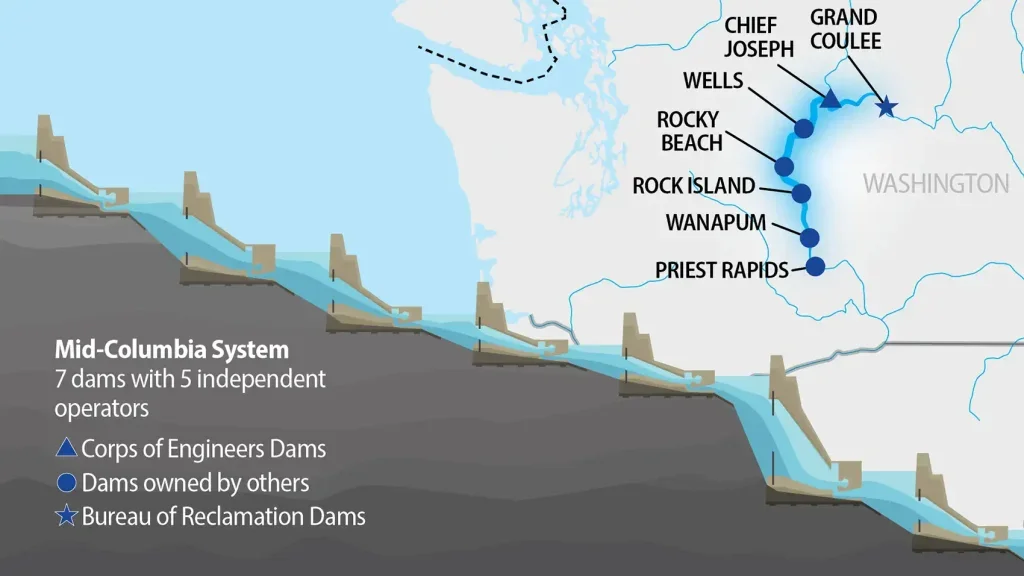
The study, funded by the US Department of Energy’s Hydropower and Hydrokinetic Office, combined river flow and production cost models to compare coordinated and uncoordinated operation.
Under the fully coordinated scenario, the seven dams were modelled as if they were centrally dispatched, with the objective of minimising production costs across the Western Interconnection. Under the uncoordinated scenario, the dams were divided into four groups according to their owner or power marketer.
The modelling found that all seven dams generated more electricity under coordinated operation. According to the researchers, coordination allowed storage levels and releases to be optimised across the cascade, enabling more water to be used for generation rather than spilled.
Each of the seven plants also recorded higher annual revenues under the coordinated scenario, with increases ranging from 2.8% to 4.3%.
“The coordinated case results in 3.3% higher revenue [across the seven dams] than the uncoordinated case, both because of the greater amount of generation and because the full Mid-Columbia resource is better able to generate during hours that are more advantageous for the system.”
Cole said coordination could allow operators to manage releases so that more water is available across the cascade during periods of higher electricity prices.
If an upstream plant retains water in anticipation of changing grid conditions, less water can be available to downstream facilities when prices are high. Under coordinated operation, an earlier upstream release could mean “there would be more water for all of the plants to be able to produce during the highest-price hours.”
NLR said coordinated operation could also improve the ability of the plants to prepare for and respond to periods of grid stress.
The research comes as hydropower operators in the western US consider their potential participation in developing day-ahead electricity markets.
“One of our motivations for doing this is the development of day-ahead markets in the West,” Cole said. “All of the dam owners are evaluating whether they might want to join these markets.”
NLR said the work was intended both to support Grant PUD’s strategic decision-making and assess the wider implications of coordination for hydropower operators and energy planners across the Western Interconnection.
“The collaboration with NLR presented an opportunity for Grant PUD to pair their deep experience in Mid-Columbia operations with the laboratory’s grid modeling capabilities to gain targeted insight as they navigate critical strategic decisions,” Cole said.
“Together, we delved into a complex question of particular interest to a relatively small group of utilities,” Cole said. “And in supplementing Grant PUD’s nuanced in-house expertise with NLR’s large-scale modeling tools and capabilities, we arrived at answers with potential to address Grant PUD’s problem while also informing a broader set of hydropower operators and utility energy planners and capturing impacts across the broader Western Interconnection.”
The findings have been published in the journal Energy.


