
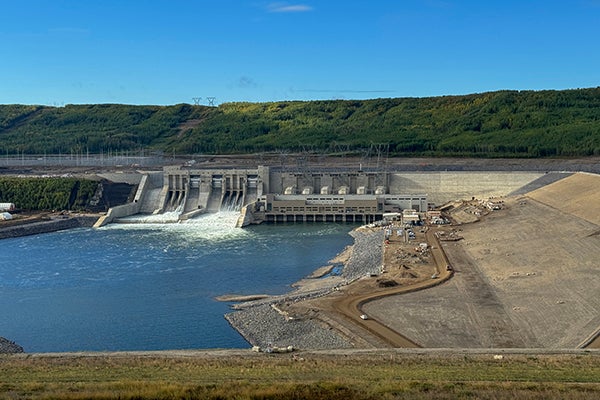
Knight Piésold Canada has received an Award of Excellence in the Water Resources category at the 2026 Canadian Consulting Engineering Awards for its temporary civil works at the Site C hydropower project.
The company served as lead designer for Peace River Hydro Partners, the main civil works contractor, providing detailed design and construction monitoring for works used to divert the Peace River during construction of the dam, generating station and spillways.
The scope included six diversion cofferdams up to 35 m high, seepage control, slope stabilisation and site-wide water management.
Construction required river diversion alongside deep excavation, with the team managing variable flows, severe weather and short seasonal construction windows. Knight Piésold said it combined geotechnical, hydraulic and environmental engineering with real-time instrumentation monitoring, adjusting designs as excavation exposed ground conditions.
The company said the temporary works performed throughout construction, including during extreme events, while keeping work areas stable and dry.
“We are honoured to be recognized for our work on one of the largest infrastructure projects in Canada,” said Sam Mottram, Managing Principal, Knight Piésold Canada. “Temporary works are critical infrastructure, and Site C showed us why. Our project team adapted the design as conditions changed, which allowed the permanent works to be built safely.”
Owned by BC Hydro, Site C is now officially named the John Horgan Dam and Generating Station. The 1,230 MW facility on the Peace River in northeastern British Columbia was commissioned in 2025 and generates approximately 5,100 GWh a year.
The award was presented on 15 October in Toronto. The project also received an Award of Excellence in the Energy & Industry category at the 2026 ACEC-BC Awards for Engineering Excellence earlier this year.
“Site C showed us what an integrated design-construction model can deliver,” Mottram added. “The construction-stage engineering approaches we developed at Site C carry over directly to future hydroelectric and other major infrastructure projects around the world.”


