

Construction of the Polihali Dam in Lesotho’s eastern highlands is advancing towards impoundment, while geotechnical investigations are moving forward for the proposed Oxbow Hydropower Scheme. Together, the works mark progress on the two main objectives of the Lesotho Highlands Water Project’s second phase: increasing water transfers to South Africa and expanding electricity generation in Lesotho.
The latest material from the Lesotho Highlands Development Authority (LHDA) describes a programme at different stages of delivery. At Polihali, the main dam, saddle dam, intake tower and outlet structures are under construction. Oxbow, a planned 120MW underground peaking station, is progressing through investigations, preliminary engineering and environmental assessment. The access road network needed to support the main construction works has already been completed.
The project builds on a bilateral framework established through the 1986 treaty between Lesotho and South Africa, which reaches its 40th anniversary in 2026. Phase I, comprising the Katse and Mohale dams, the 72MW ‘Muela Hydropower Station and associated tunnels, was inaugurated in 2004. Phase II will extend that system through Polihali, a concrete-lined gravity transfer tunnel connecting its reservoir to Katse, and the Oxbow scheme.
Raising Polihali
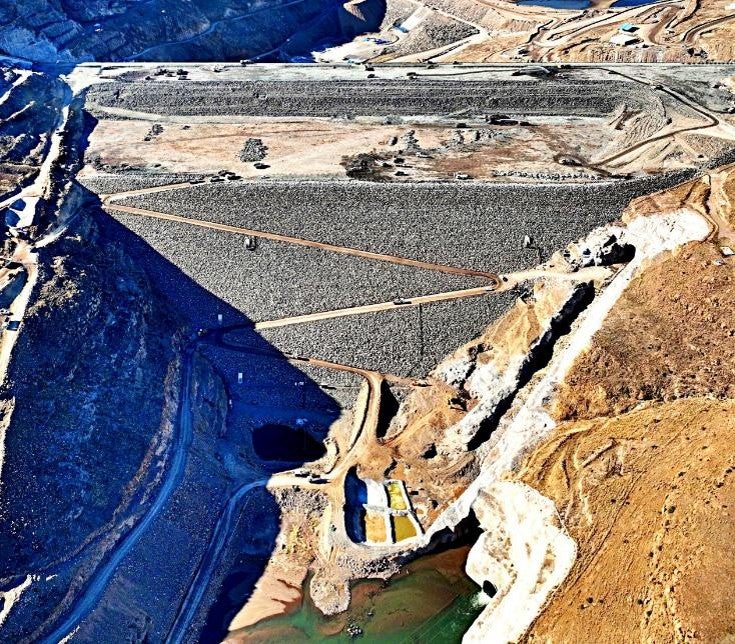
In its 8 July update, LHDA reported that Polihali Dam construction was 50% complete and on track for the start of impoundment during the 2027/2028 rainy season. Overall completion of the dam is expected in 2029.
The 166m-high concrete-faced rockfill dam is being built approximately one kilometre downstream of the confluence of the Khubelu and Senqu, or Orange, rivers. Its reservoir will have a storage capacity of 2,325 million m3. Phase II will enable annual water deliveries to South Africa to increase incrementally from 780 million to 1,270 million m3.
Rockfill placement is one of the most advanced elements of the dam works. By the end of June, 9.6 million m3 had been placed, representing 67% of the rockfill, at an average rate of 26,000m3 per working day. These figures relate to the rockfill component rather than overall dam completion.
The upstream concrete curb and rockfill reached elevation 2020m in mid-May, slightly ahead of the construction programme, and elevation 2024m by the end of June. The next milestone identified by LHDA was to bring the downstream rockfill up to the same level as the upstream rockfill and curb.
Concrete work on the main dam’s internal and external plinths was complete, and casting of the starter slabs for the upstream face was underway. Located beside the toe slab or plinth, these reinforced concrete panels provide the starting point for construction of the main face slab. The upstream curb provides a clean, competent surface for that work.
The associated 43m-high concrete-faced rockfill saddle dam was also progressing. By the end of June, its wall contained 375,627 cubic metres of rockfill. Internal and external plinth concrete works were complete, while the upstream curb had reached elevation 2047m.
Alongside embankment construction, work was continuing on the 100m-high, 21m-wide intake tower. Final excavation and concrete construction were progressing at the spillway, with excavation of the plunge pool also underway.
The bottom outlet tunnel incorporates a 2.2m-diameter compensation pipe for downstream river releases. This outlet will also supply a small 4.4MW hydropower station, adding a generation component at Polihali itself.
LHDA’s July update reported zero fatalities on the Polihali Dam project. Employment stood at 2,709 people at the end of April, including 2,062 semi-skilled employees, 99% of whom were Basotho nationals.
Defining the Oxbow scheme
While Polihali’s construction progress is visible above ground, the next stage at Oxbow focuses on understanding the conditions in which its underground infrastructure would be built.
In its 5 October update, LHDA announced the award of two geotechnical investigation contracts for Oxbow, the preferred hydropower scheme within Phase II. The proposed station would supplement ‘Muela and operate as a peaking plant for six hours a day, seven days a week, helping to meet domestic electricity needs and reduce dependence on imports.
The investigations are divided into two packages. The first, awarded to Open Ground Resources for R6 million, covers geophysical investigations, field mapping and related surveys. It is expected to take approximately five months.
The second contract, valued at approximately R100 million, was awarded in early August to South Africa’s GEOMECH AFRICA. It covers intrusive subsurface investigations, including borehole drilling, in-situ testing and laboratory testing. Subcontractors include Skyhorse Aviation and Open Ground Resources of South Africa, and Germany’s Sol Experts.
This package is expected to take approximately 11 months, including nine months of field activities. The main drilling programme comprises 18 vertical, inclined and sub-horizontal boreholes, with a combined drilled length of approximately 2,648m.
In-situ investigations are expected to include hydraulic conductivity testing, groundwater piezometric level determination, Lugeon testing, hydraulic fracture stress logging and standard penetration tests. Laboratory work will examine properties including acid-soluble chloride and sulphate content, potential alkali-aggregate reactivity, water absorption and mineralogical characteristics through X-ray diffraction and petrographic analysis.
The investigations are intended to mitigate geotechnical risks associated with unknown subsurface conditions that could be encountered during construction. For the proposed underground facility, they form an important part of the preliminary engineering programme.
Engineering work began in early 2025 following the late-2024 appointment of ASG Joint Venture as engineering design and construction supervision consultant. The joint venture comprises Artelia of France, SMEC International of Australia, SMEC South Africa and Lesotho’s GWC Consulting Engineers.
Environmental and social impact assessment services began on 6 January 2025. That work is being undertaken by ELC-Consultant Joint Venture, comprising Italy’s ELC, Lesotho’s Greenway Consultancy and South Africa’s Green Gold Group. The assessment contract is expected to be completed in 2027.
Opening access to the main works
The completed Phase II access road programme provides the transport infrastructure for Polihali Dam and the transfer tunnel, including delivery of heavy construction equipment. LHDA reports an investment of R2.3 billion across four construction contracts, with 166km of roadworks completed.
The network combines rehabilitation of the 98km Northern Access Road, a new 16.1km Polihali North East Access Road and the 54km Polihali Western Access Road. The Northern Access Road runs from Pitseng to Katse village and has been repaired, resurfaced and upgraded with drainage and safety infrastructure, including replacement of joints on three major river bridges.
The north-east route connects Mapholaneng to the dam site and links it to the A1 highway. The western route connects with the Northern Access Road at Ha Seshote and extends to the Polihali Dam and transfer tunnel construction sites.
Built as a two-lane surfaced road with shoulders and passing lanes, the western route includes three major concrete bridges over the Makhoaba, Semenanyane and Matsoku rivers. Its high-load capacity is particularly important for transporting the large tunnel boring machine components required for the transfer tunnel.
The road also offers an alternative to the Moteng Pass, reducing exposure to difficult winter driving conditions. LHDA reports that the journey between Katse and Polihali, previously around eight hours on a gravel track, now takes approximately an hour on the new western route.
Construction required extensive earthworks in demanding mountain conditions. On the western road alone, 2.2 million cubic metres of material were moved, including more than 1.5 million cubic metres blasted from solid rock. Rockfalls, unstable cliff faces, high winds and the logistics of reaching remote sites added to the challenge.
Sections of the western and north-east roads lie above 2,000m. To protect the pavement works from freezing conditions, road sealing was prohibited from April to September. Route selection and construction also had to accommodate village access, pedestrian and vehicle movements, and the relocation of affected structures. On the north-east road, LHDA built replacement houses and relocated families before construction where homes encroached on the road reserve.
Across the access road programme, 3,491 jobs were created, with unskilled positions reserved for Basotho. LHDA reports approximately R8.8 million invested in skills development and more than R1.4 billion in enterprise development, including R470 million directed to Lesotho-based enterprises.
The next stages
The immediate priorities now differ across Phase II. Polihali is progressing through rockfill placement and concrete works towards the planned start of impoundment in the 2027/2028 rainy season. Oxbow’s investigation programme will establish more of the subsurface information needed for engineering, alongside an environmental and social assessment scheduled for completion in 2027.
The water transfer and generation objectives remain closely connected. Additional flows from Polihali are intended to increase generation within Lesotho as well as water deliveries to South Africa, while Oxbow would provide a further 120MW of peaking capacity. With the access network complete, Phase II’s progress will increasingly be measured through delivery of its main water infrastructure and the development of its next hydropower station.


